If you want to take your Spanish to the next level, one necessary step is learning how to use all the tenses (those that are just one word: present, preterite, imperfect; compound (the ones with haber): present perfect and past perfect; and continuous (the ones with estar) that allow you to speak about the past.
| Tense | Basic use |
|---|---|
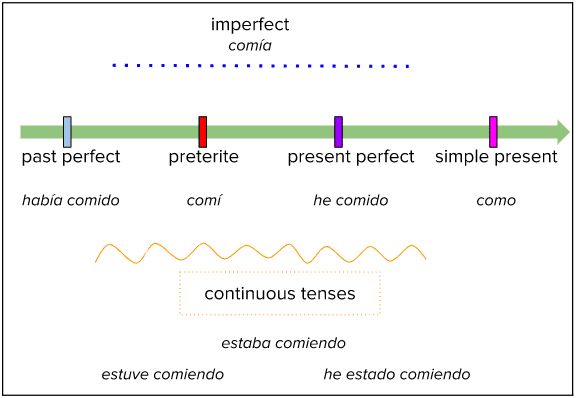
Preterite (simple and continuous) comí meaning I ate, estuve comiendo meaning I was eating | Completed actions in the past. |
Imperfect (simple and continuous) comía meaning I used to eat, estaba comiendo meaning I was eating | Background information and ongoing actions. |
Past perfect (simple) había comido meaning I had eaten | Past actions older than other past actions in the preterite. |
Present perfect (simple and continuous) he comido meaning I have eaten, he estado comiendo meaning I have been eating | Past actions completed at a time that has not yet finished or at an unspecified time in the past. Actions that started in the past and continue in the present. |
Present simple como meaning I eat | Actions that started in the past and continue in the present with desde, hace, and desde hace meaning since. |
We already have individual posts for most of these tenses that cover the basics, so do check those out if you need a refresher. Next, we're going to recap the past tenses in the indicative based on pairs that either work together or contrast with each other. Are you ready? Let’s go!
The preterite and the imperfect
The preterite is basically used to describe one completed action or a series of completed actions in the past, whereas the imperfect is used to indicate habitual actions, ongoing actions, mental states, and descriptions in the past. For a more complete overview of the contrast between the preterite and the imperfect in Spanish, check out this wonderful post.
What if you need to combine both tenses together? Let’s consider two different contexts. The first describes two actions in the past: one action interrupts a second ongoing action.
We use the imperfect for the ongoing action, whereas preterite is used for the interrupting one.
Even though the imperfect can be used in this context, the imperfect continuous is a little more common (Estaba estudiando cuando empezó a llover. meaning I was studying when it started to rain.).
The second context in which both tenses can be used together is when we narrate.
The preterite is the tense of choice to indicate consecutive actions. We use the imperfect tense for background information: time, weather, physical and mental descriptions, etc.
The preterite and the past perfect
The Spanish past perfect (aka pluperfect, here’s how to conjugate it) is used for past events that happened before another past event in the preterite tense.
The present perfect and the preterite
The Spanish present perfect is used to talk about the past without any indication of a specific time.
However, when we are specific about when something was in the past, then we use the preterite.
The present perfect is also used to indicate a past action completed at an unfinished time of the past.
The action was completed this week, a period of time that is not over yet (otherwise, you would have said “last week”). Other time markers that require the present perfect are este mes meaning this month, este año meaning this year, hoy meaning today...

The present tense vs. the present perfect
Other than the present perfect, we can use the present tense to talk about past actions that started in the past and continue in the present in these three specific contexts:
Present + desde meaning since + date | Vivo en Miami desde 2012. Translation: I have lived in Miami since 2012. |
Present + desde hace meaning for + period of time | Vivo en Miami desde hace diez años. Translation: I have lived in Miami for ten years. |
Hace meaning since + period of time + que + present | Hace diez años que vivo en Miami. Translation: It’s been ten years since I have lived in Miami. |
Have you noticed how English only uses the present perfect in these contexts? Here’s more information about the contrast between the Spanish simple present and the present perfect.
The imperfect continuous and the preterite continuous
Both tenses (here’s how you conjugate them) are used for continuous past actions. Whereas the preterite continuous refers to actions that were in progress for some time and are now completed, the imperfect continuous describes actions that were interrupted by another action, usually in the preterite tense.
The present perfect continuous and the preterite continuous
The preterite continuous is used for continuous terminated actions in the past. In contrast, we use the present perfect continuous (here’s how to conjugate it) to refer to continuous actions that started in the past and continue in the present.
Summary
That was an intricate lesson!
I hope this summary helps:
The preterite, simple and continuous, are used to indicate a past action completed at a finished time in the past. If the finished time in the past happened today, some dialects of Spanish prefer the present perfect, simple or continuous.
The present perfect, simple or continuous, are used for past actions without any specific time reference.
To talk about actions that started in the past and continue in the present, we use the present perfect (simple or continuous) or the present tense in some specific contexts.
The imperfect and the imperfect continuous are used to describe ongoing actions in the past interrupted by an action in the preterite. The imperfect, simple and continuous, can also be used in narrations to indicate background information.
The past perfect is used to describe past actions older than other more recent past actions in the preterite.
Here’s a visual summary of this post: