The past perfect, also known as the pluperfect, is commonly used to talk about a past event that happened before another event in the past.
- Anoche cuando llegué a casa alguien ya había cerrado las ventanas.Translation: Last night when I got home someone had already closed the windows.
Although it is mostly used to refer to past actions, did you know it can also be used to talk about actions related to the present moment? Find out more below!
How to form the past perfect in Spanish?
The past perfect is formed using haber as an auxiliary in the imperfect tense and the past participle of the main verb. Regular participles end in -ado, -ido, irregular ones end in -to or -cho. Click the link for a list of Spanish past participles.
Let’s go over some examples while reviewing the conjugation of haber in the imperfect tense.
Singular Subjects
- Yo había leído ese libroTranslation: I had read that book
- Tú habías escrito esa historiaTranslation: You had written that story.
- Él/ella/usted había viajado a esa ciudad.Translation: He/she/you (fml) had traveled to this city.
Plural Subjects
- Nosotros/as habíamos comido tempranoTranslation: We had eaten early.
- Ustedes habían hecho un pastel.Translation: You had made a cake.
- Vosotros/as habíais limpiado de la fiesta.Translation: You all had cleaned before the party.
- Ellos/as habían caminado la escuela.Translation: They had walked to school.
When to use the past perfect in Spanish?
The past perfect is mainly used when you want to discuss the “past of the past.” We use this tense to talk about an event that happened before another past moment. We'll call this past moment the "reference time."
The "reference time" is often a past event or situation, described using a past tense verb
Estos aretes eran de mi mamá, pero antes le habían pertenecido a mi abuela.Translation: These earrings were my mother’s, but before they had belonged to my grandmother.Sometimes, though, the reference time is understood from context. For example, if you're returning from a trip to the bank you might just say:
El banco ya había cerrado.Translation: The bank had already closed.From context, it's clear that the past moment you're referencing the moment you arrived at the bank.Sometimes another time expression, like "yesterday" or "last week" is used to set up the reference time.
Ayer, a estas horas, ya me había dormido.Translation: Yesterday, around this time, I had already fallen asleep.Some common expressions like this include ya meaning already, aún/todavía meaning still, nunca meaning never, antes meaning before, previamente meaning previously. For more examples, check out this list of Spanish expressions often used with past perfect.
When to use the past perfect in Spanish?
Now that we know how to use it in terms of time reference, let's see what you can express using the past perfect tense.
The past perfect in relation to the past
To talk about the sequence of two events in the past
When there is a sequence of two events or actions in the past and one describes something that occurred before another, the one that occurred first is expressed using the past perfect tense. For example,
Action 1
⇩
Ya habíamos planeado la bodaTranslation: We had already planned the weddingAction 2
⇩
cuando nos comprometimosTranslation: when we got engaged.In this sequence, we emphasize that the wedding had been planned before we got engaged. There is no time reference to when the actions happened, we only know both happened in the past.
To talk about results or consequences in the past
The past perfect is used to explain the reasons for a past action that ended in a certain result or consequence.
¿Por qué no cocinaste el pastel? meaning Why didn't you cook the cake?Porque no había comprado los ingredientes. meaning Because I had not bought the ingredients.For reported speech related to the past
To report what someone else has said in the past, you can use the past perfect if the original verb in the direct speech is in the preterite or present perfect.
Direct speech
Ya salí de casa.Translation: I already left the house.↓
Ya he comido en este café.Translation: I have already eaten in this cafe.↓
Indirect speech
Dijo que ya había salido de su casa.Translation: He said that he had already left his house.Dijo que ya había comido en este café.Translation: She said she had already eaten in this cafe.To learn more about reported speech in Spanish, follow the link!
To express uncertainty
To express uncertainty in the recent past, you can use the past perfect instead of present perfect.
-¿Has visto mis lentes? meaning -Have you seen my glasses?-Los había visto por aquí, pero no estoy seguro. meaning -I had seen them around here, but I’m not sure.
The past perfect in relation to the present
The past perfect is used in association to the present moment to indicate that something happened before now. It’s used in the following cases:
To express surprise
- ¿Que qué hago aquí? ¡Me habías dicho que viniera!Translation: What am I doing here? You asked me to come!
- ¿Cómo que la reunión es a las 4? ¡Había anotado que era a las 5!Translation: What do you mean the meeting is at 4? I had written down that it was at 5!
To talk about first experiences using a negative expression
- Nunca había experimentado algo así.Translation: I had never experienced anything like this before.
In the example, it is implicit that I had not had a similar experience “before now.”
- ¡No había comido ostiones antes! meaning I hadn’t eaten oysters before!
To express politeness
The past perfect can be used to show courtesy or sound more polite instead of the present perfect.
- Disculpe señora, ¿me ha pedido la cuenta?
⇣
- Disculpe señora, ¿me había pedido la cuenta?Translation: Excuse me ma’am, did you ask for the bill?
Summary
The past perfect is a compound tense that requires the auxiliary verb haber meaning have in the imperfect tense and a past participle. It is used:
to talk about a past event that happened before another event in the past (preterite, the imperfect, and the present perfect).
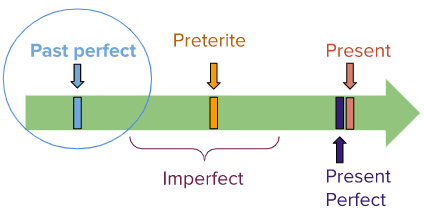
A graph that shows the temporal order of Spanish past tenses: Past perfect, preterite/imperfect, present perfect, present.
to talk about results or consequences in the past.
to express surprise, uncertainty, and politeness in reference to the present.
with words such as ya meaning already, todavía no meaning not yet, nunca meaning never as time references.
Ready to practice? Find an activity for the different uses of the past perfect here.