
When you describe the act of giving something in Japanese, you can use あげる transcribed agerumeaning to give or くれる transcribed kurerumeaning to give. For receiving, もらう transcribed moraumeaning to receive is used. You might wonder why there are two verbs that mean "to give." The usage of these words is unique to Japanese and a little hard for learners to understand at first, but you’ll be able to use them appropriately if you know the social concepts behind them. In this article, we will cover…
Important concepts to understand giving and receiving in Japanese.
How to express giving using あげる transcribed ageru vs. くれる transcribed kureru.
How to express receiving using もらう transcribed morau.
Let’s get to it!
Two important concepts to understand giving and receiving in Japanese
A language is closely connected to the society where it is used. Relationships between people and the way they see things are usually reflected in their language. Giving and receiving in Japanese are not exceptions. To understand how they work, there are two important concepts to know:
In-group vs. out-group
Speaker’s viewpoint
In-group vs. out-group
The use of giving and receiving verbs in Japanese reflects how the speaker sees their relationships. People belong to various social circles, and the relationships within the circle are mainly divided into three parts: me (or the speaker), in-group, and out-group.
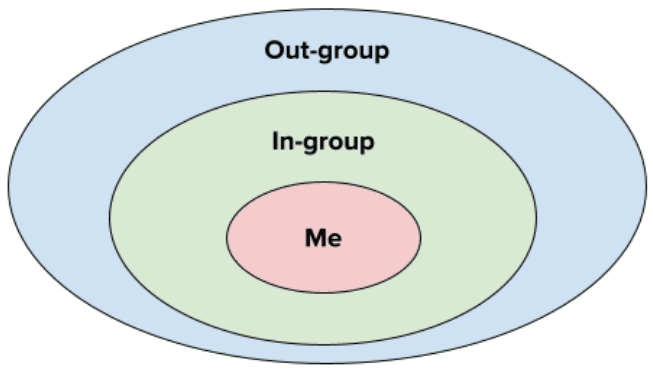
Social spheres for giving and receiving in Japanese
As shown in the picture, oneself (or the speaker) is always in the center. It is surrounded by in-group or うち transcribed uchimeaning inside people that the speaker is close to or empathizes with, such as their family and friends. Everyone else is basically included in the outermost circle, out-group or そと transcribed sotomeaning outside.
The distinction between the "in-group" and the "out-group" is similar to the distinction between “us” and “them” in English, in that it isn’t always fixed. The exact people in the "in-group" can vary based on context and based on the speaker's feelings at a given moment in time.
Speaker’s viewpoint
When choosing a Japanese giving or receiving verb, you also need to pay attention to the viewpoint, or whose point of view is being described.
- Tom gives Mary a flower.
- Mary receives a flower from Tom.
The two sentences above describe the same event, but there is a difference in viewpoint: whose perspective the description reflects Mary's or Tom's.
In Japanese, there are two general rules to decide the viewpoint.
When the speaker is involved in the situation, they present it from their own viewpoint rather than from anyone else's.
For a situation where the speaker’s in-group member is involved, it is described from that person’s viewpoint rather than from someone else's.
Keeping in mind the two concepts above, let’s move on to the actual expressions.
Giving: あげる [ageru] vs. くれる [kureru]
There are two ru-verbs in Japanese that are translated as "to give": あげる transcribed ageru and くれる transcribed kureru. The differences between the two are the direction of giving and the viewpoint the speaker takes.
あげる [ageru]
あげる transcribed agerumeaning to give is used when the direction of giving is away from the speaker or in-group members. Because of this, the giver should be the speaker or an in-group member, except in a few cases.
Possible cases of あげる transcribed ageru are as follows:
I (the speaker) give something to an in-group member
I (the speaker) give something to an out-group member
An in-group member gives something to an out-group member
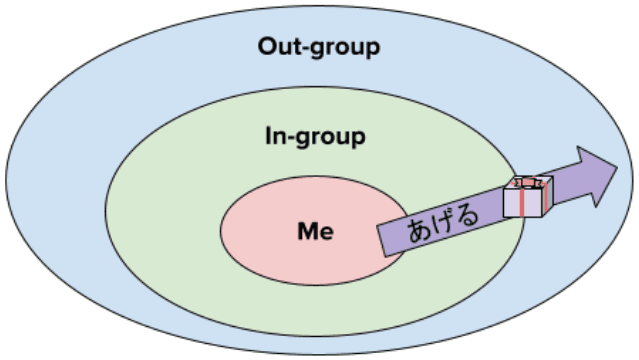
Giving with "ageru"
In sentences, the item that is given is marked by the direct object marker を transcribed o, while the following pattern is used for the giver and receiver. Please note that the giver is often omitted if it refers to the speaker.
Giver + は transcribed wa / が transcribed ga
Receiver + に transcribed ni
あげる transcribed ageru is used when the speaker describes the action from the giver’s perspective. That’s why the giver is marked by the topic marker は transcribed wa or the subject marker が transcribed ga. The receiver is marked by the destination marker に transcribed ni.
You can also use あげる transcribed ageru in negative sentences.
In negative sentences, though, あげる transcribed ageru is often used in the potential form. This form is preferred when you want to sound polite because it can indirectly express that you intended to give something but didn’t or couldn’t because of a circumstance.
くれる [kureru]
くれる transcribed kureru is used when the direction of giving is toward the speaker or in-group members. Due to the direction, the receiver should be the speaker or an in-group member. Possible cases of くれる transcribed kureru are as follows:
An out-group member gives something to an in-group member
An out-group member gives something to me (the speaker)
An in-group member gives something to me (the speaker)
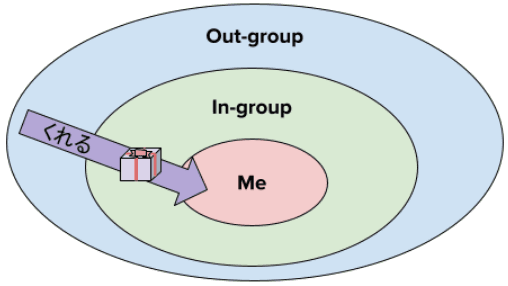
Giving with "kureru"
くれる transcribed kureru has the same sentence structure as あげる transcribed ageru. Please note that the receiver is often omitted if it refers to the speaker.
Giver + は transcribed wa/が transcribed ga
Receiver + に transcribed ni
Although the subject of a くれる transcribed kureru sentence is the giver, they describe the event from the receiver’s perspective. Due to this viewpoint, くれる transcribed kureru cannot be used in grammatical forms that focus on the giver’s intention or abilities. This means that you won't use this verb in the -tai form, volitional form, or the potential form.
To fix this, you can phrase your sentence as hearsay, with hearsay expressions like the ones below.
- ✅友達が、弟にプレゼントをくれるそうです。Transcription: Tomodachi ga otōto ni purezento o kureru sōdesu.Translation: I heard that my friend would give my younger brother a present.
- ✅友達が、「弟さんにプレゼントをあげたい」と言っていました。Transcription: Tomodachi ga, “Otōto san ni prezento o agetai” to itte imashita.Translation: My friend was saying, “I want to give your younger brother a present.”あげる transcribed ageru is used here even the gift moves from the mother to the current speaker. This is because we are quoting what the mother said, and from her perspective, the gift was traveling towards an in-group member.
Receiving: もらう [morau]
Any sentence that uses くれる transcribed kureru can be rephrased to use the verb もらう transcribed moraumeaning to receive; to get instead. You just need to swap whether the giver or the receiver is the subject of the sentence. The receiver is often omitted if it refers to the speaker.
Giver + は transcribed wa/が transcribed ga
Receiver + に transcribed ni
くれるTranscription: kureruTranslation: to give友達が (私に) クッキーをくれました。Transcription: Tomodachi ga (watashi ni) kukkī o kuremashita.Translation: My friends gave me cookies.Receiver + は transcribed wa/が transcribed ga
Giver + に transcribed ni
もらうTranscription: morauTranslation: to receive(私は、) 友達にクッキーをもらいました。Transcription: (Watashi wa) tomodachi ni kukkī o moraimashita.Translation: I got cookies from my friends.
Other than this sentence structure difference, もらう transcribed morau is similar in meaning to くれる transcribed kureru. Both verbs focus on the receiver’s perspective, and indicates that the gift moves towards the speaker.
Possible cases of もらう transcribed morau include the following:
An in-group member receives something from an out-group member
I (the speaker) receive something from an out-group member
I (the speaker) receives something from an in-group member
Here's a few more examples:
- 娘は、近所の人にお菓子をもらいました。Transcription: Musume wa kinjo no hito ni okashi o moraimashita.Translation: My daughter got snacks from the neighbor.out-group to in-group
- (私は、) 知らない人にあめをもらいました。Transcription: (Watashi wa) shiranai hito ni ame o moraimashita.Translation: I got candy from a stranger.out-group to speaker
- (私は、) 父にかばんをもらいました。Transcription: (Watashi wa) chichi ni kaban o moraimashita.Translation: I got a bag from my dad.in-group to speaker
もらう can also be used in negative sentences:
- 弟は誕生日プレゼントをもらったのに、私はもらいませんでした。Transcription: Otouto wa tanjōbi purezento o moratta noni, watashi ha moraimasendesita.Translation: My brother got a birthday present, but I did not.
- 会社の上司が厳しくて、全然休みをもらえません。Transcription: Kaisha no jōshi ga kibishikute, zenzen yasumi o moraemasen.Translation: My boss is strict, so I cannot get any days off.Here we use the potential form. As we saw in the negative form あげる, it is preferred when you want to indirectly express that you want to get something but don’t or can’t because of circumstances.
Examples: Which "giving" verb to choose?
Let's look now at some examples of different "giving" situations, and see if you can choose between using あげる transcribed ageru and くれる transcribed kureru or もらう transcribed morau.
Let’s imagine your dad got a present from his colleague. Which verb(s) would you use to describe this situation? あげる transcribed ageru or もらう transcribed morau?
That’s right! もらう transcribed morau (or くれる transcribed kureru) is more appropriate here. Your dad is an in-group member, while his colleague is not, so this is a gift traveling toward the speaker.
✅ 父は、同僚にプレゼントをもらいました。Transcription: Chichi wa dōryō ni prezento o moraimashita.Translation: My dad got a present from his colleague.out-group to in-groupNow, imagine your brother gives something to your friend. This is a gift from one in-group member (brother) to another in-group member (friend). So is it traveling towards you or away from you?
Usually, your brother is going to be considered a closer in-group member than your friend, which means that あげる transcribed ageru is going to sound most natural in this situation.
✅ 弟は、私の友達にチョコレートをあげました。Transcription: Otōto wa watashi no tomodachi ni chokorēto o agemashita.Translation: My younger brother gave chocolate to my friend.in-group (closer) to in-group (further)Using もらう transcribed morau or くれる transcribed kureru to describe this situation would sound unnatural, since these verbs are for when a gift travels towards the speaker.
❌ 私の友達は、弟にチョコレートをもらいました。Transcription: Watashi no tomodachi wa otōto ni chokorēto o moraimashita.Translation: My friend got chocolate from my younger brother.in-group (closer) to in-group (further)But what if your dad gave something to your mom? This is another case of an in-group member giving something to another in-group member, but it's trickier since your parents are both equally close to you.
In this case, you can take either perspective!
- ✅ 父が母に指輪をあげました。Transcription: Chichi ga haha ni yubiwa o agemashita.Translation: My dad gave a ring to my mom.in-group (close) to in-group (close)
- ✅ 母は父に指輪をもらいました。Transcription: Haha wa chichi ni tīshatsu o moraimashita.Translation: My mom got a T-shirt from my dad.in-group (close) to in-group (close)
The same is true if both the giver and receiver are out-group members, equally distant from the speaker.
Giving and receiving in questions
When あげる transcribed ageru, くれる transcribed kureru, and もらう transcribed morau are used in questions, the viewpoint usually switches and what matters is which way the gift is traveling relative to the listener. Let's look at an example.
A gift that travels away from the listener: あげる transcribed ageru
✅ 友達に何をあげたんですか。Transcription: Tomodachi ni nani o ageta ndesu ka.Translation: What did you give to your friends?listener to listener's in-groupGifts that travel towards the listener: くれる transcribed kureru or もらう transcribed morau
- 田中さんがその写真をくれたんですか。Transcription: Tanaka san ga sono shashin o kureta ndesu ka.Translation: Did Mr. Tanaka give that picture to you?listener's out-group to listener
- ✅ 誰にその手紙をもらったんですか。Transcription: Dare ni sono tegami o moratta ndesu ka.Translation: From whom did you get that letter?unknown to listener
However, if the speaker or the speaker's in-group are involved in the "giving" action, then あげる should still be relative to the speaker, not the listener.
What can be "given" using あげる, くれる, or もらう?
Now that we understand how the giving and receiving verbs work, let’s talk about what we give and receive. There are two rules for items that can be used with those verbs.
You can give can be tangible or intangible things.
As we saw in the examples above, people usually give and receive tangible things, such as presents, money, and flowers. However, intangible things (e.g., opportunities, breaks, information) can also be objects for giving and receiving:
- 私は彼にもう一度チャンスをあげました。Transcription: Watashi wa kare ni mō ichido chansu o agemashita.Translation: I gave another chance to him.
- プロジェクトが終わったので、会社が休みをくれました。Transcription: Purojekuto ga owatta node, kaisha ga yasumi o kuremashita.Translation: Since I finished the project, the company gave me days off.
Whatever is given should benefit the receiver.
あげる transcribed ageru, くれる transcribed kureru, and もらう transcribed morau are only used if whatever you're giving is something that the speaker thinks will be beneficial to the recipient.
母は、父にプレゼントをもらって、うれしそうでした。Transcription: Haha wa chichi ni purezento o moratte ureshisō deshita.Translation: My mom looked happy because she got a present from my dad.The present is considered beneficial to her because she was happy about it. Here is a common mistake:
- ❌ 私は、先生に宿題をあげました。Transcription: Watashi wa sensei ni shukudai o agemashita.Translation: I gave the homework to my teacher.You're supposed to do the homework to benefit yourself, not the teacher!
- ✅ 私は、先生に宿題を提出しました。Transcription: Watashi wa sensei ni shukudai o teishutsu shimashita.Translation: I submitted the homework to my teacher.This verb is better, since it expresses that the item changed hands, but doesn't imply the teacher benefitted from receiving your homework.
In this case, あげる cannot be used because homework is something that you are supposed to do for your own benefit, not the teacher’s!
Honorific verbs for "giving" and "receiving"
あげる transcribed ageru, くれる transcribed kureru, and もらう transcribed morau all have honorific forms that can be used to be more polite.
If you (or your in-group) give something to a person in a higher position, you can use the humble expression さしあげる transcribed sashiageru, rather than the あげる transcribed ageru.
先生に花束を差し上げました。Transcription: Sensei ni hanataba o sashiagemashita.Translation: We gave a bouquet to our teacher.When someone with a higher social status gives something to you, or your in-group, you can use the u-verb くださる transcribed kudasaru instead of くれる transcribed kureru.
社長がおみやげをくださいました。Transcription: Shachō ga omiyage o kudasaimashita.Translation: The company's CEO gave us souvenirs.Note that the -masu form of くださる transcribed kudasaru is くださいます transcribed kudasaimasu, not くださります transcribed kudasarimasu.
When you humbly receive something from a person in a higher position, you can use the u-verb いただく transcribed itadaku, rather than もらう transcribed morau.
上司に結婚のお祝いをいただきました。Transcription: Jōshi ni kekkon no oiwai o itadakimashita.Translation: I got a wedding gift from my boss.
To sum up
We learned how to express giving with あげる transcribed ageru and くれる transcribed kureru, and receiving with もらう transcribed morau. Here’s a summary for you:
あげる transcribed agerumeaning to give → the gift travels away from you: "we gave..."
くれる transcribed kurerumeaning to give → the gift travels towards you: "...gave us..."
もらう transcribed moraumeaning to receive → the gift travels towards you: "we received..."
Ready to practice what you've learned? Check out our giving and receiving in Japanese exercise to test your skills! Happy learning!