
Like in English, the passive voice in German is used when the focus is on the action and not on who did it. Let’s see an example.
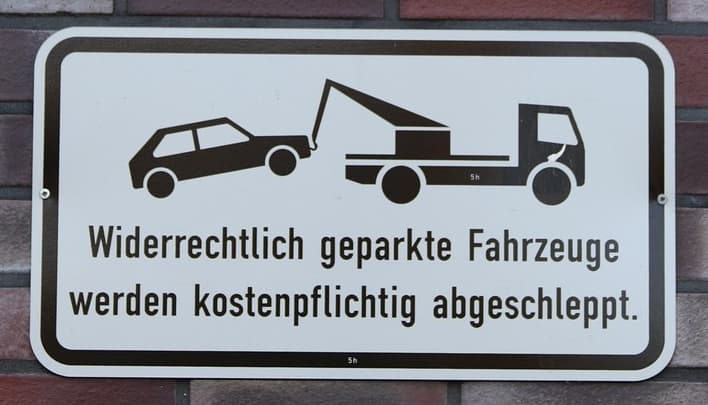
Notice that the of a passive verb undergoes the action!
In this post, we’ll go through all the most important things about the German passive voice: the different ways to form it, how to use it in different types of sentences, and when you might want to use it. Let’s have a look!
Statal passives vs. processual passives in German
In German, there are two different forms of the passive voice: the statal passive and the processual passive.
The statal passive describes the result of a completed action (a.k.a. a state):
Die Reifen sind gewechselt.Translation: The tires have been changed.The action of changing the tires is complete.The processual passive describes an ongoing action or a process:
Die Reifen werden gewechselt.Translation: The tires are being changed.The action of changing the tires is ongoing.
They are both versions of the passive voice, which we can see when we compare the meanings above to the active voice equivalent below:
However, when we’re using the term “passive voice” in German, we’re usually talking about the processual passive, so this is the form we’ll cover in this post. If your curiosity has been piqued about the statal passive, though, check out our post on how to use the statal passive in German!
How to form the processual passive voice in German?
The processual passive voice is formed by combining the auxiliary verb werden and the past participle form of the main verb.
past participle
(ge…-t / ge…-en / irregular)
Changing the tense of werden changes the tense of the passive verb. Although it exists in all the , the good news is that the most common tenses of the passive voice are the present tense and the simple past. Use the following formulas:
Present tense | werden (present) + past participle |
Simple past | werden (simple past) + past participle |
Present perfect | sein + past participle + worden |
Past perfect | sein + past participle + worden |
Check out this table of the German passive voice to see all the forms of werden and sein that you’ll need to fully conjugate verbs in the passive voice.

German sentence structure: Active voice vs. passive voice
We’ve seen, now, how to form a passive verb in German. Let’s look more closely about how this affects the form of the complete sentence. The easiest way to understand this is to compare the sentence structure in the active voice to the passive voice. The basic differences are:
Classically, in the active voice:
ACTIVE Role Case agent (do-er)
subject
nominative
undergoer
direct object
accusative
In the passive voice:
PASSIVE Role Case undergoer
subject
nominative
agent (do-er)
optional, follows von / durch meaning by
dative / accusative
Let’s look at some pairs of active and passive sentences and discuss the differences!
| Active voice | Passive voice |
|---|---|
Ich bezahle die Rechnung. Translation: I am paying the bill. | Die Rechnung wird bezahlt. Translation: The bill is paid. |
| Active voice | Passive voice |
|---|---|
Mein Bruder parkte den Van in einer engen Parklücke. Translation: My brother parked the van in a tight parking spot. | Der Van wurde in einer engen Parklücke geparkt. Translation: The van was parked in a tight parking spot. |
When to use ‘von’ and ‘durch’ in the passive voice?
In the passive voice, you can use von or durch to add the agent back into a passive sentence, much like you would use “by” in English. How do you choose which to use? Follow these rules:
Use von to introduce a person or animal who does the action.
Use durch to introduce things, companies, or concepts who perform an action.
Also remember that von is a dative preposition while durch is an accusative preposition, so the case of the agent will depend on which preposition you use. Let’s see how this works.
| Active voice | Passive voice |
|---|---|
Die Mechanikerin reparierte gestern den Motor. Translation: The mechanic repaired the engine yesterday. | Der Motor wurde gestern von der Mechanikerin repariert. Translation: The engine was repaired by the mechanic yesterday. |
| Active voice | Passive voice |
|---|---|
Die Versicherung bezahlt hoffentlich die Reparaturen. Translation: The insurance company hopefully pays for the repairs. | Die Reparaturen werden hoffentlich durch die Versicherung bezahlt. Translation: The repairs are hopefully paid by the insurance company. |
How to form the passive voice with modal verbs in German?
We can use German modal verbs in the passive voice as well, but the resulting sentence structure looks a little different. In this case the modal verb is the conjugated into a tense, while werden is pushed to the end of the sentence, remaining in its infinitive form. Let’s look at some examples!
| Active voice | Passive voice |
|---|---|
Johann muss die Geburtstagsfeier vorbereiten. Translation: Johann has to prepare the birthday party. | Die Geburtstagsfeier muss vorbereitet werden. Translation: The birthday party must be prepared. |
| Active voice | Passive voice |
|---|---|
Er konnte die Einladungen verschicken. Translation: He could mail the invitations. | Die Einladungen konnten verschickt werden. Translation: The invitations could be mailed. |
When to form the passive with impersonal ‘es’?
In German, you’ll need to form the passive using the impersonal es if, in an active sentence, the verb does not assign accusative case to its object. In other words, we form the passive this way when the active version of the sentence has no true direct object, as in the example below:
Because there is no direct object in the sentence above, that direct object will not automatically be made into the subject of the passive. But we still need to fill the “position” in the sentence associated with the subject.
One way we can fill this position is to use impersonal es, which looks like this:
However, if the active version of the sentence has other elements such as an indirect object, an adverb, or a prepositional phrase, you can use them in the first position instead, which might look like this:
This means that passive sentences in German do not necessarily need to have a subject. Let’s look at our two options through a couple other examples!
Active voice | Ich danke meiner Mutter. Translation: I thank my mother. |
Passive with es | Es wird meiner Mutter gedankt. Translation: My mother is thanked. |
Passive with no subject | Meiner Mutter wird gedankt. Translation: My mother is thanked. |
Active voice | Er antwortete auf meine Einladung. Translation: He answered (to) my invitation. |
Passive with es | Es wird auf meine Einladung geantwortet. Translation: My invitation is answered. |
Passive with no subject | Auf meine Einladung wird geantwortet. Translation: My invitation is answered. |
How to use impersonal ‘man’ when there’s not an agent?
In German, you can use the impersonal pronoun man meaning one, they, someone as the subject of an active sentence if there is no specific agent. This creates an effect much like the passive, but it uses an active verb. For example:
The meaning of this is similar to the passive, but the structure of the sentence is different:
Here are a few more examples:
Impersonal man | Man feiert den Geburtstag. Translation: They celebrate the birthday. |
Passive | Der Geburtstag wird gefeiert. Translation: The birthday is celebrated. |
Impersonal man | Man räumt das dreckige Geschirr ab. Translation: They clean up the dirty dishes. |
Passive | Das dreckige Geschirr wird abgeräumt. Translation: The dirty dishes are cleaned up. |
Summary
Let’s review the most important information of this article:
In the passive voice, the subject undergoes the action.
To form the passive voice use the auxiliary verb werden and a past participle. It exists in all tenses.
The usual German word order rules still apply.
To include the do-er (agent) in a passive sentence, use the dative preposition von meaning by, for animate agents, or the accusative preposition durch meaning by, for other agents.
Modal verbs follow the same rules in the passive voice: they carry the tense, the main verb is in the past participle + werden.
When the active voice sentence has no direct object, use the impersonal es or a sentence element (for example an indirect object, an adverb, or a prepositional phrase) in place of a subject in a passive voice sentence.
To achieve a similar meaning to the passive while using an active verb, just make the impersonal pronoun man as the subject.
If you want to practice the passive voice and apply what we discussed today, check out our German passive voice exercises. Or, if you’d rather learn more about German passives, check out our follow-up on the statal passive voice in German.