
A subordinate clause (or “dependent clause”) is a chunk of a sentence that has its own and , but which is there to complete or add information about another part of the sentence. For example:
As you can see, the verb comes at the end of the subordinate clause above. That’s different from the usual word order in German, where the verb comes second!
In this post, we’ll cover the basics of how to form German subordinate clauses: the words that introduce them, the word order to use, and some of the situations where you’ll want to use them. Ready to learn why subordinating conjunctions are sometimes called “verb kickers” in German? Read on!
What is a subordinating conjunction?
Subordinating conjunctions are small words like “although,” “because,” “if,” and “while,” which introduce subordinate clauses.
As stated above, subordinate clauses are phrases with a subject and a verb that are used to complete or add information about some other part of a sentence. They are called subordinate clauses because they support the main idea.
What is the word order for German subordinate clauses?
German subordinate clauses will generally end with a verb. We saw an example of this in the introduction.
However, clauses can sometimes have more than one verb and different types of verbs will follow slightly different rules. Which verb or which part of the verb goes at the end?
In the sections below we’ll talk about how to form German subordinate clauses with different types of verbs. Let’s have a look!
Subordinate clauses with one verb
In German subordinate clauses with one verb, the verb is kicked to the end.
Imagine you want to combine the following two sentences:
Notice that ist is after es in the second sentence. To connect the sentences, we can use the conjunction obwohl meaning even though. This way, we get:
Do you see what happened to ist? In the independent sentence, “Es ist eine schwierige Sprache,” ist was in “second position,” where the basic German word order rules you would expect to see it. But in the subordinate clause, ist comes at the very end!
Sometimes, it’s easier to understand what’s going on in German when you imagine that a subordinating conjunction, like obwohl, is a soccer player and the conjugated verb, like ist, is the soccer ball:
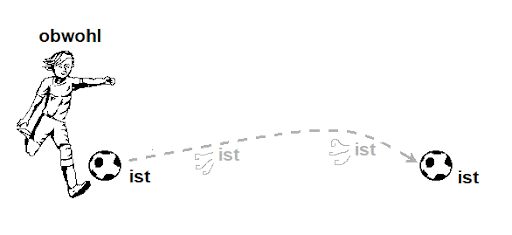
This image is even more helpful when we talk about clauses with more than one verb!
Subordinate clauses with two verbs
When a subordinate clause has two verbs, the conjugated verb gets kicked to the end. What does that mean?
A conjugated verb is a verb that agrees with the subject and often has a tense marking on it. German clauses with two verbs typically only have one conjugated verb, which will come before the other verb (usually called the “main verb”).
In the main clause, the word order usually looks like this:
Subject
Verb 1
(conjugated)
Object
Verb 2
(fixed)
But in a subordinate clause, the conjugated verb is “kicked” to the end, so the pattern looks like this instead:
Conjunction
Subject
Object
Verb 2
(fixed)
Verb 1
(conjugated)
In these cases, as we see in the schema above, both verbs are at the end, but Verb 1 got kicked to the other side of Verb 2, so the conjugated verb comes last.
Subordinate clauses with separable-prefix verbs
When using a separable-prefix verb in a subordinate clause, there’s another little rule to remember. In a subordinate clause, the verb and the prefix “get together” again!
Separable verbs consist of two parts: a verb and a small associated word called a “prefix.” Let’s look at the verb anrufen meaning to call as an example.
In a main clause, parts are separated: the prefix goes to the end of the clause.
Sie ruft ihn an.Translation: She is calling him.In a subordinate clause, though, the verb moves to the end, so the verb and the prefix get back together!
Ich weiß nicht, ob sie ihn anruft.Translation: I don’t know if she is calling him.
How to put German subordinate clauses first?
In German, it’s often possible to put the subordinate clause before the main clause, just like in an English sentence like “Because it was raining, I brought an umbrella.” However, when you do this in German there’s a quick grammar rule to remember about the word order in the main clause!
If a verb-final subordinate clause comes before the main clause, then the order of the main clause’s subject and conjugated verb is reversed. Compare:
- Ich liebe Deutsch.Translation: I love German.
- Obwohl Deutsch eine schwierige Sprache ist, liebe ich Deutsch.Translation: Even though German is a difficult language, I love it.The order of the subject and the verb is reversed!
For these cases, simply remember to put both conjugated verbs very close together, one before and one after the comma.

Which German conjunctions kick the verb to the end?
Almost all German subordinating conjunctions kick the verb to the end. We can sort them into categories depending on the role the clause they introduce typically performs in the sentence. Let’s have a closer look!
Conjunctions of time
Conjunctions of time are used to introduce clauses that describe when something happened (also known as temporal clauses). The most common ones are:
- alsTranslation: when (for past events that don’t repeat)
- wennTranslation: when (for future, present, or repeated events)
- bevorTranslation: before
- bisTranslation: until
- nachdemTranslation: after
- seit(dem)Translation: since
- währendTranslation: while
Almost all conjunctions of time kick the verb to the end. For example:
- Wir kannten uns schon, als wir noch in der Schule waren.Translation: We had already known each other when we were still in school.
- Sag mir bitte Bescheid, wenn du zu mir kommst.Translation: Please let me know when you come to my place.
Conjunctions of reason
Conjunctions of reason are used to give the reason or cause of a situation (also known as causal clauses). The most common conjunctions of Reason in German are:
- daTranslation: because
- weilTranslation: because
- weshalbTranslation: which is why
- denn*Translation: because
The first of these are verb-kicking conjunctions:
- Ich muss viel Deutsch lernen, als ich bald nach Deutschland ziehen werde.Translation: I need to study a lot of German because I’m going to move to Germany soon.
- Ich bleibe zu Hause, weil ich krank bin.Translation: I’m staying at home because I am sick.
- Peter hatte Annes Wecker ausgestellt, weshalb sie den Bus verpasste.Translation: Peter had silenced Anne’s alarm clock, which is why she missed the bus.
However, the last one on that list, denn does not kick the verb to the end:
Conjunctions of condition
Conjunctions of condition are words like “if” that introduce a condition under which something else will or will not happen (also known as conditional clauses).
- fallsTranslation: if (formal)
- wennTranslation: if
Both of these are verb-kicking conjunctions:
Conjunctions of contrast
Conjunctions of contrast introduce something that opposes or contrasts with the main situation but wasn’t. Some common examples include:
- auch wennTranslation: even though
- obwohlTranslation: even though, although
- obgleichTranslation: even though
- selbst wennTranslation: even if
- währendTranslation: while, whereas
- wobeiTranslation: although, taking into account that
- wohingegenTranslation: whereas
All of these are verb-kicking conjunctions:
- Das glaube ich dir, auch wenn ich es nicht selbst gesehen habe.Translation: I believe you even though I haven’t seen it myself.
- Ich helfe dir, obwohl ich wenig Zeit habe.Translation: I’ll help you although I have little time.
- Seine Präsentation verlief sehr gut, obgleich er nicht wirklich vorbereitet war.Translation: His presentation went smoothly even though he wasn’t really prepared.
- Selbst wenn ich Zeit hätte, würde ich unseren unfreundlichen Nachbarn nicht helfen.Translation: Even if I had time, I wouldn’t help our unfriendly neighbors.
Conjunctions of comparison
Conjunctions of comparison are used to compare two clauses. The two main ones are verb-kicking:
- jeTranslation: the more… the more…
- umsoTranslation: all the more… the more…
For example:
- Je länger du mich ansiehst, desto schöner finde ich deine Augen.Translation: The longer you look at me, the more I like your eyes.
- Umso schneller wir arbeiten, umso schneller sind wir fertig.Translation: The faster we work, the earlier we are finished.Literally: The more quickly we work, the more quickly we are finished.
Conjunctions of manner
Conjunctions of manner introduce clauses that describe how or in what manner something is done (also called modal clauses). Here are the most common ones:
- als obTranslation: as if
- indemTranslation: by
- ohne zuTranslation: without
All of them are verb-kicking:
- Es kam mir vor, als ob sie überhaupt keine Lust auf die Arbeit hätte.Translation: It seemed to me as if she really didn’t want to do this work.
- Ihr könntet mir helfen, indem ihr mir ein bisschen Wandfarbe holen geht.Translation: You guys could help me by going to get some wall paint.
- Ohne die Hintergründe genau zu kennen, tat er seine Meinung darüber kund.Translation: Without even knowing the reasons behind it, he expressed his opinion on it.
Conjunctions for indirect questions
Indirect questions are questions embedded inside of a statement. Here are some examples in English:
- I wondered why he was here early.
- I asked whether she was ready.
In English, they’ll either start either with a question word or with a conjunction like “whether”. We do the same in German, but in German the verb is always kicked to the end of the subordinate clause:
- Ich verstehe nicht, warum du mich nicht angerufen hast.Translation: I don’t understand why you didn’t call me.
- Können Sie mir bitte sagen, wo sich das Rathaus befindet?Translation: Could you please tell me where the town hall is located?
- Keiner hat gesehen, wer das Auto gestohlen hat.Translation: No one has seen who stole the car.
- Weißt du, wann der Bus kommen soll?Translation: Do you know when the bus is supposed to arrive?
- Ich frage mich, wovon er nachts träumt.Translation: I wonder what he dreams about at night.
If the question that is reported is a yes / no question, we use the conjunction ob meaning if:
- Ich weiß nicht, ob sie Deutsch spricht.Translation: I don’t know if she speaks German.
- Er fragt, ob wir einen Sitzplatz reservieren müssen.Translation: He is asking if we have to reserve a seat.
- Ich möchte wissen, ob etwas passiert ist.Translation: I would like to know if something happened.
Complement conjunctions
A complement clause is usually there to complete the meaning of the main clause. In English they usually begin with “that.” In German, the only two words in this category are dass meaning that and ob meaning if. There’s always a comma before these two words in German.
- Ich weiß, dass der Amazonas der längste Fluss der Welt ist.Translation: I know that the Amazon is the longest river in the world.
- Ich weiß nicht, ob der Amazonas der längste Fluss der Welt ist.Translation: I don’t know if/whether the Amazon is the longest river in the world.
As you can see, both are verb-kickers!
Summing up
Let’s recap what we’ve looked at today:
Most but not all subordinating conjunctions in German “kick” the verb to the very end of the clause, so the subordinate clause have this word order:
Conjunction - Subject - Object - Verb
When the subordinate clause comes before the main clause, the subject and verb in the main clause switch their positions.
If you want to review what you’ve learned here, check out this list of German subordinating conjunctions with examples, which includes even very rare ones! Or, if you’d rather practice, try out our German subordinate clause activities!