Superlative are words used to show that something has the most or least of a particular quality within a group of three or more. Here are some examples:
(Read on to find out the answers!)
In this post, we’ll be taking a closer look at:
how superlative adjectives are formed
how to use superlative adjectives in your sentences and speaking
This will be the best, most interesting post you’ll ever read on superlative adjectives!
What is a superlative adjective?
A superlative adjective is a word used to show that one particular person, place, thing, or idea within a group of three or more has the most or least of a quality.
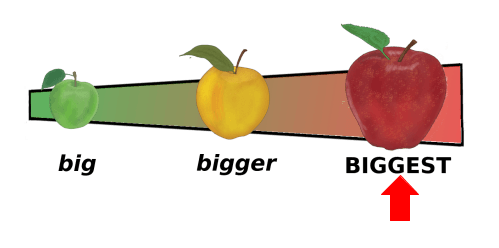
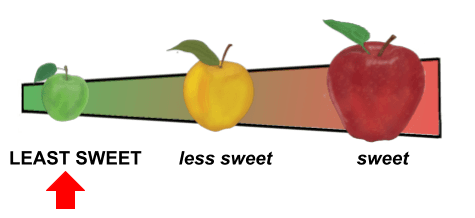
It’s important to remember that superlative adjectives are only used to describe something or someone taken from a group of three or more. When comparing only two nouns (or noun phrases), you will use an English comparative adjective like bigger or less sweet.
This apple is bigger than that one. ← two apples
This apple is less sweet than that one. ← two apples
How to form a superlative adjective in English?
There are a few different ways to turn a regular adjective into a superlative adjective in English:
There are also some words that have irregular superlative forms. Let’s look at each one more closely!
When to use ‘-est’ to make a superlative?
Use -est to create a superlative adjective when the adjective is one or two . These adjectives are superlatives of majority (X > all).
All one-syllable adjectives have a superlative with -est:
- big → biggest
- small → smallest
- short → shortest
- tall → tallest
Some two-syllable adjectives that end in particular letters or sounds also have a superlative with -est.
All two-syllable adjectives ending in -y (pronounced “ee”):
- happy → ✅ happiest
- friendly → ✅ friendliest
- sleepy → ✅ sleepiest
- skinny → ✅ skinniest
Some adjectives with other endings as well:
- little → ✅ littlest
- yellow → ✅ yellowest
- handsome → ✅ handsomest
- polite → ✅ politest
- common → ✅ commonest
For more examples and details, check out this longer list of two-syllable adjectives with -est superlative forms!
When to use ‘most’ to make a superlative adjective?
You can usually add the word most before an adjective to form a superlative if the adjective is two syllables (help·ful) or longer (in·cred·i·ble). These adjectives also describe the noun with the large amount of a quality.
- helpful → most helpful
- normal → most normal
- incredible → most incredible
When to use ‘least’ to make a superlative adjective?
You can add the word least to any English adjective to form a superlative adjective that describes a noun with the small amount of a quality.
- tall → least tall
- clever → least clever
- intelligent → least intelligent
English speakers often avoid using superlatives with least, especially with shorter adjectives. The best way to do this is to use an adjective with the opposite meaning and a superlative with -est or most:
- He is the least fat cat. → ✅He is the thinnest cat.
Two important points:
If there is a word with an exact opposite meaning, the form with least can be completely unacceptable.
- ❌least good → ✅worst
Otherwise, it is usually more polite to choose the form of the sentence that uses the least insulting adjective. For example:
- least intelligent vs. stupidestleast intelligent is more polite, because stupid is insulting
- least interesting vs. most boringleast interesting is more polite, because boring is usually insulting
‘Good,’ ‘bad,’ and other irregular superlatives
As always, there are some irregular superlative adjectives. All of these are superlatives of majority (X > all). Here’s the list:
| Adjective | Superlative |
|---|---|
good | best |
bad | worst |
little | least |
much | most |
far | farthest / furthest |
many | most |
well | best |

How to use English superlative adjectives in a sentence?
We use superlative adjectives to compare one noun that has the most/least of a quality to a group of individual nouns that do not have the most/least of that quality. Superlative adjectives usually come before the noun that they describe:
However, there are a few rules that make superlative adjectives different from other kinds of adjectives:
Always use the (the) or a (my, your, their...) before a superlative adjective.
Because a superlative adjective describes a specific person, place, or thing (the one with the most/least of a quality), the noun after a superlative adjective is always .
Usually this means that it will need to come after a definite article (the) or a possessive adjective (my, your, his, her, its, our, their). Here are the patterns:
- the
superlative adjective
noun
These are the best books in the library.Rafa is the fastest runner of all time. possessive adjective
superlative adjective
noun
Dolly is my best friend.That book is his most interesting story ever.This is our worst experience of all of our vacation.
You can sometimes drop the noun.
With enough context, you can delete the noun after a superlative adjective. For example:
Many girls on the soccer team are muddy, but Sandra is the muddiest (girl).Several players are good at tennis, but the best (player) is Rafa.He has written a lot of books, but this one is his least interesting (book).But notice that the definite article or possessive adjective is not dropped! We still need those!
We measured the children...✅...and the tallest child was Bill.✅...and the tallest was Bill.❌...and tallest was Bill.You can use superlative adjectives with plural nouns.
You can use a superlative adjective with a plural noun, if you are picking out a group with the most or least of a quality.
I ate the two reddest apples in the basket.The speaker selected two apples. No other apple in the basket was redder than either of the apples selected.The fastest runners finished the race in less than two minutes.Each runner that finished the race in less than two minutes was faster than every runner that took more than two minutes to finish the race.You can use more than one superlative adjective at a time.
You can make two comparisons at once by using two superlative adjectives:
The red apple is the biggest and (the) sweetest.I want the biggest, sweetest apple.
Those are the most important rules. Let’s look at a few more details that will help you use superlative adjectives in comparisons!
How to describe the other nouns in the group?
When you make a comparison with superlative adjectives, it is important to describe the group that you are choosing from as well.
Often the group of nouns you are choosing from is clear from the context. For example:
(Margot is describing her vacation)
“The worst day was Saturday, because it rained.”She is choosing from the days when she was on vacation.(Margot and I are making a pie. She gives me a bag of apples)
“Can you hand me the three reddest ones?”We are choosing from the apples that are in the basket she gave me.
However, if there is not enough context already, you can describe the group of nouns explicitly in a few ways:
Using a prepositional phrase ( + noun):
- She is the nicest girl in the room.
- That is the fastest bird in the flock.
- Margot ate the biggest piece of the cake.
Using the of all + noun:
- She is the nicest girl of all the girls in the class.
Using time phrases like last year, ever, or of all time:
- She is the nicest girl ever.
- She is the nicest girl of all time.
- This was Mr. Albert’s least interesting lecture all year.
Using a relative clause:
- She is the nicest girl that I know.
Have a look at this sheet for more examples and tips about how to describe the group!
Summing up
Superlative adjectives are quite useful when you want to compare one thing (or one group) to everything else in a collection. Remember these points:
Superlative of Majority (X > all)
adjective + -est → for short adjectives
most + adjective → for long adjectives
Superlative of Minority (X < all) = least + adjective
Always use the definite article the or a possessive adjective with superlative adjectives
You can use a variety of tools to describe the group you are choosing from, including:
a prepositional phrase
the phrase (out) of all + noun
a time phrase
a relative clause
Want to get some practice with superlative adjectives? Check out the English superlative adjectives activity we’ve prepared for you!
Oh yeah! Those questions I asked at the beginning? Here are the answers: