
English speakers use the past simple (or “simple past”) for basically one thing: to talk about an action that is completely finished and that happened before the moment of speech.
In this post we’ll be looking at:
How the past simple is formed
How the past simple is used
My students often looked at the past simple and thought it was hard. But it’s actually one of the easiest verb tenses in English! Let’s get down to brass tacks and talk about the past simple.
How to form verbs in the simple past?
In the simple past, most verbs are formed like this:
root
Verbs that follow this pattern are called “regular verbs.” However, some common English verbs have irregular simple past forms, which do not follow this rule. For example:
| Irregular verb root | Irregular simple past verb form |
|---|---|
be | was / were |
go | went |
do | did |
get | got |
have | had |
The good news is that each verb has only one simple past form that you can use with any subject!
| Irregular verb root | Irregular simple past verb form |
|---|---|
I / you / we / they / he / she / it | wanted |
I / you / we / they / he / she / it | got |
Let’s talk a little bit more about regular and irregular verbs in the simple past.
How to pronounce simple past verbs in English?
In most cases, the written -ed is pronounced like a simple transcribed dor transcribed tstuck on the verb root:
- walkedTranscription: wakt
- lovedTranscription: luhvd
However, if the root ends with a transcribed dor transcribed tsound, you need to add an extra syllable so that your past tense can be heard:
- wantedTranscription: wahn·tid
- gradedTranscription: gray·did
How to spell simple past verbs in English?
There are some basic spelling rules (with many exceptions!) that you’ll want to look out for:
verbs that end in -e: just add a -d
chase → chasedverbs that end in a consonant + -y: change the -y to -i and add -ed
marry → marrieddouble the final consonant in certain words:
plan → plannedrefer → referred
What are irregular past tense verbs in English?
Irregular verbs in English are verbs that have a past tense form and/or a past participle form that is not formed by just adding -ed.
Have a look at this list of English irregular verbs. Like most irregular verb charts, it has three columns. The second column is the simple past verb form. We’ve given you two different versions:
a version organized by difficulty
a version organized into some general categories based on the pattern they follow

How to make sentences in the simple past
Here is how to make different kinds of sentences in the simple past:
Affirmative sentence:
subject
simple past verb
I visited the museum.Negative sentence:
subject
did
not / n't
root
I did not visit the museum.I didn't visit the museum.Question:
did
subject
root
Did I visit the museum?Which museum did I visit ?
Affirmative sentences are easy! Just use the verb in its simple past form. It is called the “simple” past, because you only need to use one verb.
But negative sentences and questions require another verb: did, which is called the “auxiliary verb.” Did is the simple past form of do.
Forming sentences in the simple past is just like forming sentences in the English simple present! Compare:
| Simple Present | Simple Past | |
|---|---|---|
| Statement | He visits the museum. | He visited the museum. |
| Question | He does not visit the museum.Who visits the museum? | He did not visit the museum.Who visited the museum? |
| Negative | Does he visit the museum? | Did he visit the museum? |
| Main Verb be | Is he at the museum?He is not at the museum. | Was he at the museum?He was not at the museum. |
| Corrections | No! He does visit the museum! | No! He did visit the museum! |
Just as in the simple present, we follow these rules in the past simple:
Use the simple past/present form of the main verb:
In affirmative sentences
When the main verb is be
In questions about the subject
Use the auxiliary do:
In most questions
In most negative sentences
To correct someone
Check out our posts on English negative sentences and English questions to learn more! Now that you see the basic structure of the past simple, when do you use it? That’s pretty simple too!
When to use the simple past?
We almost always use the simple past to talk about something that finished in the past (before the moment of speech).
When we are talking about an action that happened in the past and is over/finished, we use the simple past. Take a look at Tom’s story about his bad day at work:
Now, look at this timeline with all the horrible things that happened to Tom:
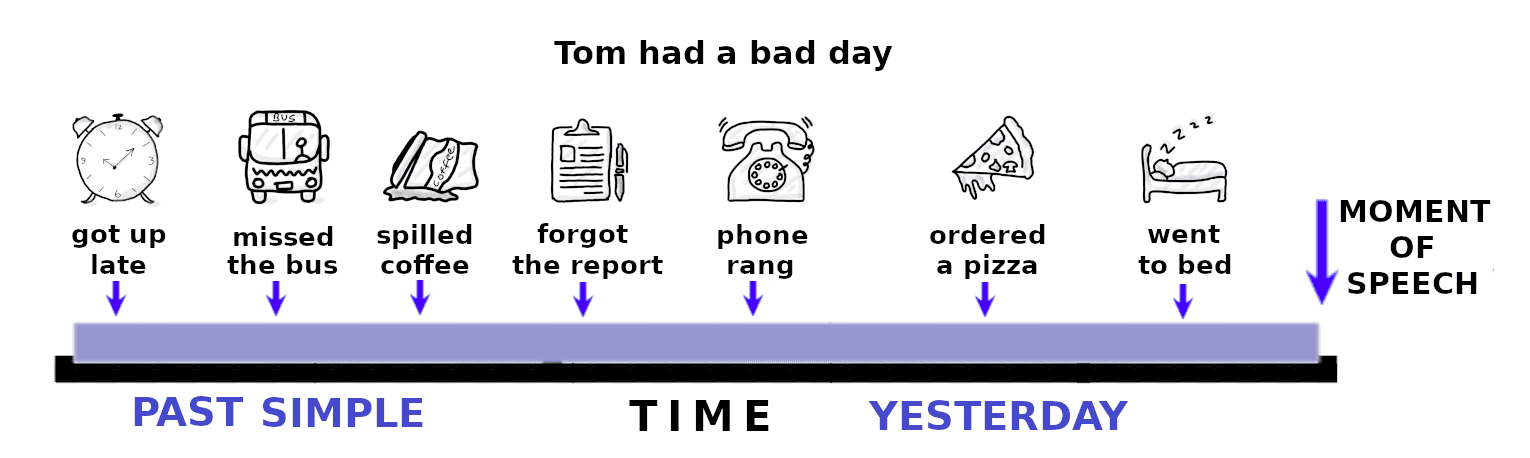
Did you notice?
All actions happened in the past.
All actions are now finished.
That’s a perfect example of how to use the simple past to tell us what happened to you in the past.
Summing up
This time around you’ve seen just how easy it is to make and use the past simple.
To form the past simple:
root
-ed / irregular form
To use the past simple in sentences, we usually follow these rules:
Affirmative sentence: subject + simple past
Question: did + subject + root
Negative sentence: did + not + root
Use the simple past to talk about finished actions in the past and actions that happened once, before the moment of speaking.
If you’d like to practice telling a simple past story, why not take advantage of our English simple past practice activities? Good luck!