We use the past perfect in English to talk about something that happened before another past event or moment. The past perfect connects the first event to the second event:
The party started in the past.
John bought the cake in an earlier past.
The past perfect connects the two events: the first says what the situation was like when the second happens.
You’ll also sometimes hear the past perfect used to talk about an imaginary past.
In this post, we’ll take a look at how to form the past perfect and how to use it. Ready to reach way back into the story that happened before the story? Let’s take a crack at the past perfect, then!
How to form the past perfect in English?
To form a verb in the past perfect in English, combine the had with the form of the .
past participle
The auxiliary verb is have
We use the auxiliary have for all of the perfect tenses (past perfect, present perfect, and future perfect). For the past perfect we use the past tense, which is always had.
I hadwe hadyou hadthey hadhe/she/it hadThe main verb is a past participle
A regular past participle is formed like this:
+ -ed
wanted, played, decoratedMany common verbs have an irregular past participle, for example:
be → beengo → gonetell → told
So an affirmative sentence, a negative sentence, and a question in the past perfect will look like this:
Affirmative: John had gone to the supermarket before the party.
Negative: John hadn’t told his parents about the party before they got home.
Question: Had John decorated the house before the guests arrived?
How to use the past perfect in English?
There are two main situations where we use the past perfect in English:
To talk about something that happened before another event in the past
To talk about an imaginary past (in conditional or hypothetical sentences)
Let’s talk about these two uses.
The past perfect for an earlier past event
English speakers use the past perfect to talk about something that happened before another past event or past moment.
- I had already cooked dinner when Kelsey arrived.I cooked before Kelsey arrived (an event)
- I had already cooked dinner by 5pm.I cooked before 5pm (a moment)
We specifically use the past perfect when:
Our focus is on the later event or moment. So we are only mentioning the first event because it helps us understand the second one.
The first event or moment is completely finished when the second event starts.
Look at this difference between these different past tenses:
| Past simple: | I cooked dinner then Kelsey arrived.
|
|---|---|
| Past continuous: | I was cooking dinner when Kelsey arrived.
|
| Past perfect: | I had cooked dinner when Kelsey arrived.
|
Keep reading to see a longer example of how to use the past perfect in a story!
What time markers to use with the past perfect?
You will usually see the past perfect used with time markers that tell us (or emphasize) which action happened first, like:
already | I had already turned on the lights when Kelsey arrived. |
before | I had turned on the lights before Kelsey arrived. |
by + time | I had turned on the lights by 3pm. |
by the time (that) | I had turned on the lights by the time (that) Kelsey arrived. |
after | Kelsey arrived after I had turned on the lights. |
yet | I had not turned on the lights yet when Kelsey arrived. yet is only used in questions and negative sentences! |
Because the past perfect verb is only there to help you understand the situation at a later time, we usually do not describe exactly when the past perfect verb happened. If you do use a time phrase that describes an exact time, we understand that that is the time of the later moment.
At six o’clock, I had turned on the lights.
❌ The lights went from off to on at exactly six o’clock.
✅ At six o’clock, the lights were already on.
However, you can use the past perfect with an exact time if that time impacts our understanding of the later situation.
- ✅Kelly wanted to go see the new Marvel movie, but I had seen it the day before.The amount of time between the two events is important to our understanding of the situation, so including this information makes sense.
How to use the past perfect to describe a continuing action or state?
You can use the past perfect for an event that took a long time to happen or to describe a state that continued for a while. However, we only use the past perfect if the event or state finished before or (more often) exactly when the second event or time arrived. For example:
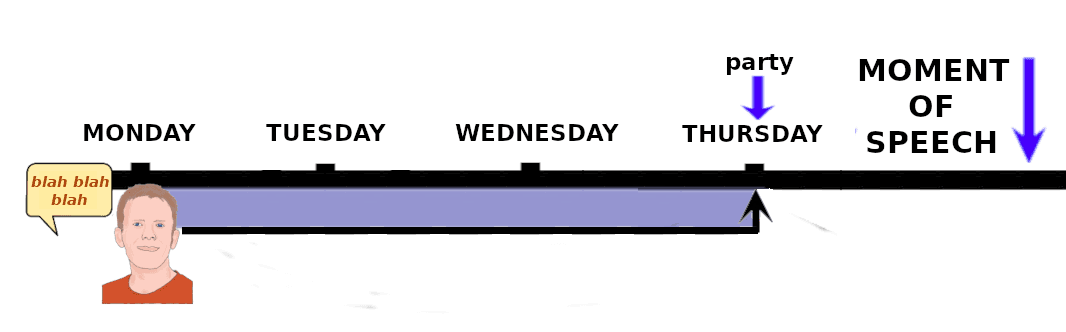
To show that the action continued for a while, use time markers like these:
for + length of the period of time
since + start of the period of time
until + end of the period of time
all + general name for length of time (afternoon, day, week, year…)
Can you see how the amount of time the action or state continued impacts our understanding of the situation in the sentences below?
- John had talked about getting a dog for two years, so he got one.John got a dog after lots of thought.
- John had talked about getting a dog all afternoon, so he got one.John got a dog without enough planning.
You can actually use several other tenses in this situation without changing the meaning or the focus:
- ✅John was talking about getting a dog for two years, so he got one.
- ✅John had talked about getting a dog for two years, so he got one.
- ✅John had been talking about getting a dog for two years, so he got one.
Using the past continuous or past perfect continuous just places more emphasis on the fact that the event happened nonstop or in a very repetitive way. The past perfect sounds more like it happened occasionally, but more than once during a period of time.

How to use the past perfect for an imagined past?
We also use the past perfect to talk about an imagined past that did not happen. We usually do this in two circumstances:
Wishes about the past → I wish I had planned better.
→ If I had planned better, I would have been on time for school.
How to use the past perfect for wishes about the past?
One more use of the past perfect is for making wishes about the past. Usually we make wishes about the past to say that we are unhappy with what actually happened. For example:
- I wish I had studied more for my test.
- I wish she had bought me a motorcycle for my birthday.
- We wish he hadn’t come to the party.
We use the past perfect for any wish about the past. The focus does not need to be on another past moment or event:
- I wish I had studied more for my test. I wanted a better grade.focus on a past time
- I wish I had studied more for my test. I feel bad now.focus on a present time
- I wish I had studied more for my test. My mother will be furious.focus on a future time
How to use the past perfect in conditional sentences?
We use the past perfect in English conditional sentences that talk about purely hypothetical past situations. These sentences say that because the condition did not happen, the result did not happen. For example:
Notice that we use the past perfect in the “if” part of the sentence, called the conditional clause. The conditional clause sets up the situation that should lead to a certain outcome. In the other clause (called the result clause), we use a modal verb and the present perfect tense.
An example of the past perfect in a story
Let’s look at a longer example! In this story, we are focusing on what happened during John’s party. As you read, see if you can figure out the reason why the past perfect is being used in each case. Here are your options:
something that happened before the “main event” (John’s party)
a wish about the past
a conditional sentence about a past that didn’t happen
In the following uses, it was talking about an earlier past event:
- I’d worked all day…
- …because John had called me…
- …he had already finished decorating…
- …John had bought a yellow cake…
- …I hadn’t met anyone except John yet!
In the following uses, we were talking about a wish about the past:
- I wish he’d thrown the party on Friday…
- I wish he’d chosen a chocolate cake instead.
- I also wish he hadn’t invited so many people.
In the following uses, we were giving a hypothetical conditional about the past:
- If he had told me he didn’t need help anymore, I could have had a nap after work.
Summing up!
Here’s what to remember about the past perfect in English:
How to form it: had + past participle
How to use it:
To talk about something that was finished before the past action (either a short or long action)
To talk about an imaginary past situation: wishes or conditional sentences about the past
The past perfect isn’t all that hard after all! Check out these English past perfect activities to practice more past perfect to help make your next story fun and interesting for your friends!