
Have you ever started saying a in Spanish and then completely frozen up midway because you can’t figure out which verb you need? The freeze is real. For example, you might wonder whether you need ir meaning to go or irse meaning to leave... Then this post is for you! We will focus on challenging duos of verbs in Spanish and our aim is that next time, you can make the right choice without freezing up! For this post we will focus on the following pairs:
ir vs irse
to go vs to leave, to depart, to go away
ir vs venir
to go vs to come
llevar vs traer
to take vs to bring
Are you ready to take on these challenging verbs? Excellent, let’s get started!
What is the difference between ‘ir’ and ‘irse’ in Spanish?
Let’s start with ir meaning to go and irse meaning to leave, to depart, to go away, two of the most popular “challenges” for Spanish learners!
The most important difference between these verbs is that ir is used to talk about movement from point A to point B, while irse focuses on the act of leaving or departing from a place.
In the first example, the focus is on the destination (the office), whereas in the second example the focus is on the act of departing and the destination is not important.
The verb ir(se) is an irregular verb in most tenses, click here to review the conjugations of ir. Here are some additional tips to keep in mind for the verb ir meaning to go:
It is often followed by a Spanish preposition of movement such as a meaning to, toward, hacia meaning to, toward and then followed by the place. For example:
Nosotros vamos a la casa de mi abuelita los sábados.Translation: We go to my grandma’s house every Saturday.It can be used to talk about an implied A → B movement in a method of transportation. For example:
Ustedes van en avión y llegan mañana, ¿verdad?Translation: You are going (to point B) by plane and arrive tomorrow, right?It can be used to express the future in Spanish in the construction: ir (present tense) + a + infinitive
Ellas van a tomar sus exámenes finales mañana.Translation: They are going to take their final exams tomorrow.
Here are some additional tips to keep in mind for the verb irse meaning to leave, to depart, to go away:
It requires a Spanish reflexive pronoun for its construction, as you can see from its infinitive form "irse":
me meaning myselfnos meaning ourselveste meaning yourselfos meaning yourselves - Spainse meaning himself, herself, yourself formalse meaning themselves, yourselves - LATAMWhile ir meaning to go focuses on the movement from point A to point B, irse meaning to leave, to depart, to go away focuses on the act of leaving a specific place (here). Irse doesn't require that you specify the end point/destination, but you can if you want! For example:
Me voy porque estoy muy cansado. Que tengas un buen día.Translation: I’m leaving because I am very tired. Have a good day.Notice how the example focuses on the action of leaving, but doesn’t require an end point or destination?Nos vamos a Cartagena por dos semanas.Translation: We’re leaving for Cartagena for two weeks.A destination CAN be included, but this example still puts the focus on the act of leaving!Irse can also focus on the act of leaving at a specific time. For example:
Nos vamos a las 5 de la mañana para que no nos toque la hora pico.Translation: We are leaving at 5 am so that we don’t catch rush hour.Irse is often paired with the preposition de meaning from to talk about point of origin.
Se fueron de la fiesta a las 10 de la noche.Translation: They left the party at 10 pm.
Quick check-in!
Which construction would you choose?
Esteban and I are leaving soon:
- Esteban y yo vamos pronto.
- Esteban y yo nos vamos pronto.
The answer is B!
What is the difference between ‘ir’ and ‘venir’ in Spanish?
Ir meaning to go and venir meaning to come can be tricky, because the choice depends on the perspective of the speaker rather than the listener. In Spanish, the main difference is the point of view of the speaker and the direction of said movement.
Ir meaning to go moves AWAY from the speaker.
 Vamos al cine esta tarde.Translation: We’re going to the movies this evening.Notice how the speaker(s) is not present at the point of destination, meaning they are going “there.”
Check out the previous section for some additional notes on the uses of ir (to go).
Venir meaning to come moves TOWARD the speaker.
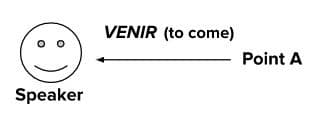 Mariela y José vinieron a mi casa para celebrar mi cumpleaños.Translation: Mariela and José came to my house to celebrate my birthday.Notice how the movement is from a different place TO the speaker; the speaker is at the point of destination, meaning they are coming “here.”
Here are some additional things to keep in mind for the verb venir meaning to come:
It can be used to talk about movement of speaker + audience to a NEW place as well! For example:
Voy al concierto de los Rabanes, ¿quieres venir conmigo?Translation: I am going to the Rabanes concert, do you want to come with me?It can be paired with the preposition de meaning from to talk about point of origin or place of origin. For example:
Vengo del (de + el) centro comercial. Había muchísima gente.Translation: I came from the mall. There were a ton of people.Sebastián Yatra viene de Colombia y es un cantante famoso.Translation: Sebastián Yatra is from Colombia and he is a famous singer.
Now, let’s revisit the idea of toward/away from the speaker with the pairs llevar vs traer!
What is the difference between ‘llevar’ and ‘traer’ in Spanish?
Llevar meaning to take and traer meaning to bring are a challenging pair because, in English, we don't necessarily place a ton of importance on their difference. We often use them interchangeably, like in the following examples:
I am going to take some snacks for the road.
or
I am going to bring some snacks for the road.
You could pick “to take” or “to bring” and communicate practically the same idea. In Spanish, however, these two verbs are not interchangeable! They are both tied to the speaker and their location (like ir meaning to go and venir meaning to come).
Traer meaning to bring implies that the object is coming toward the speaker.

For example:
Mi mamá me trajo un poco del ajiaco que hizo ayer.Translation: My mom brought me some of the ajiaco she made yesterday.
Llevar meaning to take implies that the object is going away from the speaker.

For example:
Mañana llevaré una merienda grande al trabajo porque no tendré tiempo para desayunar.Translation: Tomorrow I will take a large lunch to work because I will not have time to eat breakfast.
Another tip about llevar meaning to take and traer meaning to bring: they are often found with indirect object pronouns (me, te, le, nos, os, les) to refer to the person that things are being taken to or brought to. For example:
To sum it up
There are some verb pairs that can be a little challenging — but not impossible — in Spanish. Let’s revisit the ones from this post once again:
Ir meaning to go is used to talk about movement from point A to point B, while irse meaning to leave, to depart, to go away focuses on the act of leaving or departing from a place.
Ir meaning to go and venir meaning to come are both verbs of movement. Ir meaning to go moves AWAY from the speaker while venir meaning to come moves TOWARD the speaker.
Traer meaning to bring implies that the object is coming toward the speaker, while llevar meaning to take implies that the object is going away from the speaker.
Don’t get discouraged if a native speaker corrects you. The most important thing is to keep practicing. Eventually these will start coming more naturally to you.
To help you out with some additional challenging verbs, check out "What’s the difference between saber vs conocer, acordarse vs recordar, and other challenging pairs?"
While you perfect your Spanish, though, why don’t you check out these practices that can help you start to master these verbs?