The Russian alphabet is not Latin-based, which might be intriguing and off-putting for learners at the same time. There are 33 letters in it, some look very similar to English ones (which does not mean they always represent similar sounds), and some look very different. The good news is, once you know what sounds the letters stand for, and familiarize yourself with a few basic pronunciation rules, reading in Russian is a piece of cake.
Would you like to know what sounds the letter Я, Ж, or Ф represent? Follow me, and you’ll be able to read any text in Russian out loud (even if you don’t understand a word in it)!
What is the Russian alphabet?
The Russian alphabet is a set of 33 letters that are used to read and write Russian. The modern Russian alphabet is based on the Cyrillic script which dates back to the 9th century. Believed to be designed by Saints Cyril and Methodius and their disciples, Cyrillic was spread among various Slavic peoples together with Christianity. Today, Cyrillic script serves as a base for writing in Russian, Belarusian, Bulgarian, Serbian, Ukrainian, and other languages.
Let’s now take a look at the 33 letters of the Russian alphabet, what they are called, and how they are used in words.
| Letter | Name of letter | Sound | Letter in a word |
|---|---|---|---|
Аа | transcribed a | like ‘a’ in ‘army’ | армия transcribed ARmiyameaning army |
Бб | transcribed be | like ‘b’ in ‘bank’ | банк transcribed bankmeaning bank |
Вв | transcribed ve | like ‘v’ in ‘volcano’ | вулкан transcribed voolKANmeaning volcano |
Гг | transcribed ge | like ‘g’ in ‘gas’ | газ transcribed gasmeaning gas |
Дд | transcribed de | like ‘d’ in ‘domestic’ | дом transcribed dommeaning house/home |
Ее | transcribed ye | like ‘ye’ in ‘yes’ | есть transcribed yestmeaning to eat |
Ёё | transcribed yo | like ‘yo’ in ‘yogurt’ | ёлка transcribed YOLkameaning fir tree/Christmas tree |
Жж | transcribed zhe | like ‘s’ in ‘measure’ | женщина transcribed ZHENshchinameaning woman |
Зз | transcribed ze | like ‘z’ in ‘zebra’ | зебра transcribed ZYEBrameaning zebra |
Ии | transcribed ee | like ‘ea’ in ‘easy’ | идея transcribed iDYEyameaning idea |
Йй | transcribed ee KRATkaye | like ‘y’ in ‘yoga’ | йога transcribed YOgameaning yoga’ |
Кк | transcribed ka | like ‘k’ in ‘karate’ | карате transcribed karaTEmeaning karate |
Лл | transcribed el | like ‘l’ in ‘leader’ | лидер transcribed LEEdyermeaning leader |
Мм | transcribed em | like ‘m’ in ‘mother’ | мама transcribed MAmameaning mom |
Нн | transcribed en | like ‘n’ in ‘night’ | ночь transcribed nochmeaning night |
Оо | transcribed o | like ‘a’ in ‘mall’ | озеро transcribed Ozirameaning lake |
Пп | transcribed pe | like ‘p’ in ‘pilot’ | пилот transcribed piLOTmeaning pilot |
Рр | transcribed er | like ‘r’ in ‘rocket’ | ракета transcribed raKYEtameaning rocket |
Сс | transcribed es | like ‘s’ in ‘stop’ | стоп transcribed stopmeaning stop |
Тт | transcribed te | like ‘t’ in ‘tennis’ | теннис transcribed TEnismeaning tennis |
Уу | transcribed oo | like ‘oo’ in ‘moon’ | утро transcribed OOtrameaning morning |
Фф | transcribed ef | like ‘f’ in ‘fund’ | фонд transcribed fontmeaning fund |
Хх | transcribed kha | like ‘h’ in ‘head’ | хлеб transcribed khlyepmeaning bread |
Цц | transcribed tse | like ‘t’s’ in ‘let’s go’ | цветок transcribed tsviTOKmeaning flower |
Чч | transcribed che | like ‘ch’ in ‘cheese’ | чай transcribed chaymeaning tea |
Шш | transcribed sha | like ‘sh’ in ‘shorts’ | шорты transcribed SHORtymeaning shorts |
Щщ | transcribed shcha | like ‘sh’ in ‘sheep’ | щит transcribed shcheetmeaning shield |
ъ | transcribed TVYORdyi znak | no sound | объект transcribed abYEKTmeaning object |
ы | transcribed y | сlose to ‘i’ in ‘pin’ | сыр transcribed syrmeaning cheese |
ь | transcribed MYAKHkiy znak | no sound | олень transcribed aLYENmeaning deer |
Ээ | transcribed e | like ‘e’ in ‘end’ | эхо transcribed Ekhameaning echo |
Юю | transcribed yu | like ‘u’ in ‘use’ | юг transcribed yukmeaning south |
Яя | transcribed ya | like ‘yu’ in ‘yummy’ | ягода transcribed YAgadameaning berry |
Some of the sounds made by Russian letters are common sounds in English, for example, к transcribed k, м transcribed m, н transcribed n, ч transcribed ch, с transcribed s, в transcribed v, з transcribed z, л transcribed l.
Other Russian letters represent sounds that are present in English, but they are pronounced a little differently when you're speaking Russian, for instance:
Russian р transcribed r is rolled unlike the English one.
б transcribed b and п transcribed p are less “explosive” than English ones.
х transcribed kh is more intense and comes from the back of one’s throat, in comparison to the English “h” which is basically just a puff of air.
т transcribed t and д transcribed d are pronounced closer to front teeth.
There are some other sounds in Russian that do not exist in English at all: ц transcribed ts, щ transcribed shch, and ы transcribed y. You should probably hear them to master them.
Here are some other important (and curious!) things you need to know about the letters in the Russian alphabet:
There are no words in Russian which begin with ы, ь, and ъ, so these letters do not have capital versions.
Some of the most frequently-used letters are о, е, а, и, н, т, с.
Some of the most rarely-used letters are ъ, ё, ф, щ, э, ц, ю.
The letter Ёё is often written/typed as Ее.
The last letter of the alphabet, я transcribed ya, is also a first person pronoun “I”. When someone acts selfishly or talks too much about themselves, people may say “Я” - последняя буква алфавита! transcribed ya - pasLYEDnyaya BOOKva alphaVEEtameaning “I” is the last letter of the alphabet!.
What does Russian cursive look like?
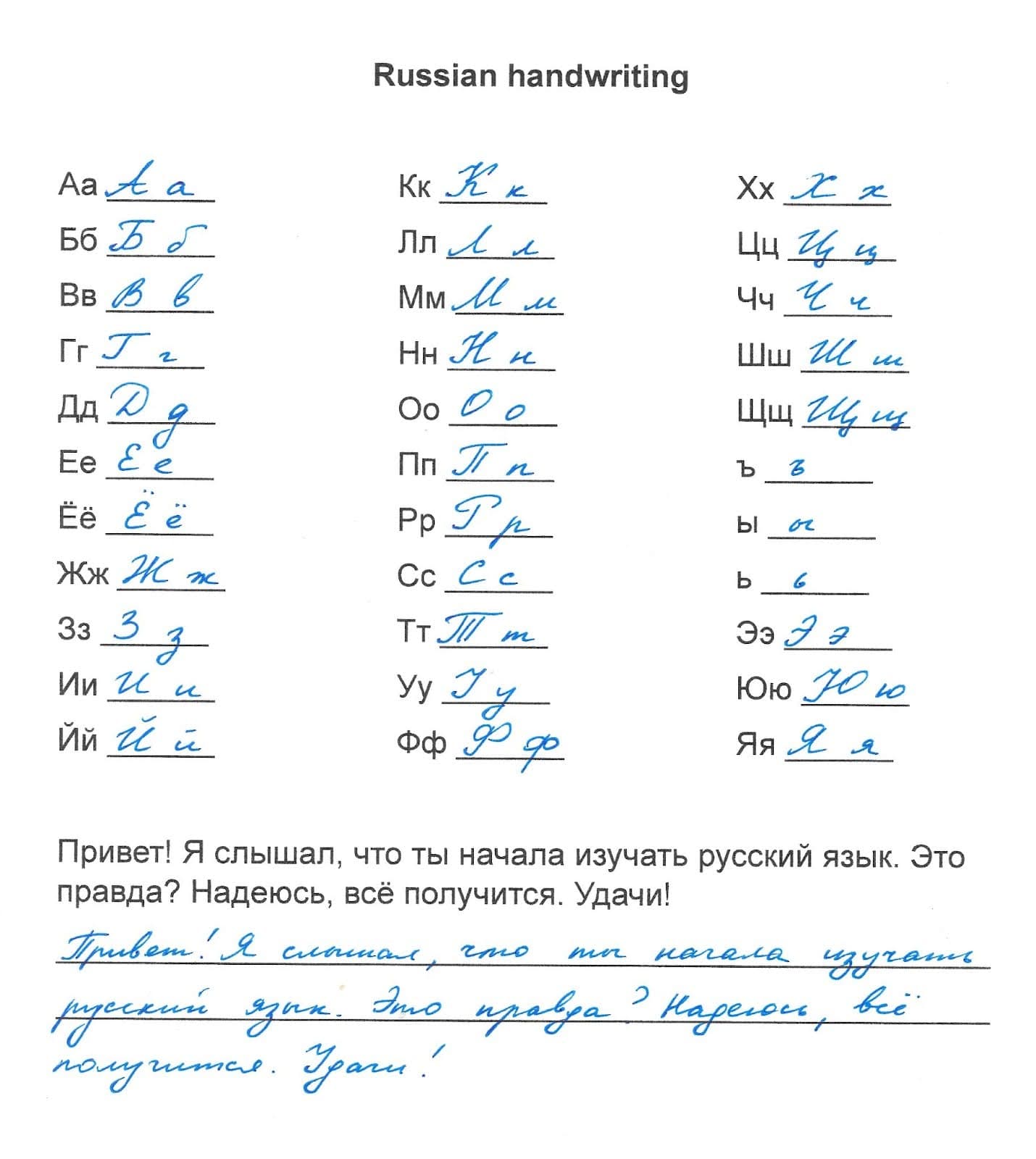
Russians hardly ever use block letters (or print letters) when they write longhand. All Russians learn cursive, or handwriting, at school, and people use it throughout their lives. To understand any handwritten document, such as a note, a birth certificate, or a graffiti, you need to know what Russian letters look like when they are written by hand.
Although there are great personal variations of letter styles, slope, etc., here is an example or handwritten Russian letters and a short text:
How to pronounce Russian vowels?
Although there are 10 vowel letters in the Russian alphabet, they actually represent only 6 vowel sounds: а transcribed a, э transcribed e, и transcribed ee, о transcribed о, у transcribed oo, ы transcribed y. Four letters, е, ё, ю, and я, actually stand for a combination of two sounds: y + vowel (е transcribed ye, ё transcribed yo, ю transcribed yu, я transcribed ya).
One important thing to know about the vowel letters in Russian is that they may change the pronunciation of the preceding consonant. Five vowel letters are called “hard vowels” because the consonant that comes before them remains hard (receiving its "normal" pronunciation). Five other vowels are called “soft vowels” because the consonant that comes before them becomes soft, or "palatalized."
Hard | а transcribed a | э transcribed e | о transcribed o | у transcribed oo | ы transcribed y |
Soft | я transcribed ya | е transcribed ye | ё transcribed yo | ю transcribed yu | и transcribed ee |
To give you an idea of what “soft consonant” means, you sort of insert a short “y” (as in “you”) between the consonant and the following vowel, for example:
| Hard | Soft |
|---|---|
матч transcribed machmeaning match | мяч transcribed myach/myachmeaning ball |
ров transcribed rofmeaning ditch | рёв transcribed ryof/ryofmeaning roar |
лук transcribed lookmeaning onion | люк transcribed lyook/lyukmeaning manhole lid |
мэтр transcribed metrmeaning maestro/maitre | метр transcribed myetr/myetrmeaning meter |
быть transcribed bytmeaning to be | бить transcribed beetmeaning to beat |

How to pronounce Russian consonants?
Most consonants in Russian can be hard (as they appear in the alphabet) or soft. This characteristic of a consonant depends on what comes after it. Consonants become soft, or palatalized:
Before the vowels и transcribed ee, e transcribed ye, ё transcribed yo, ю transcribed yu, я transcribed ya, e.g.:
мята transcribed myaTAmeaning mint
лёд transcribed lyotmeaning ice
боль transcribed bolymeaning pain
петь transcribed pyetymeaning to sing
Sometimes before other soft consonants:
честь transcribed chesytymeaning honor
здесь transcribed zydyesy
When you pronounce a soft consonants, the middle part of your tongue will move a bit upwards, closer to the hard palate. To give some English examples of this contrast:
[k] is hard in “car” and soft in “keen”
[t] is hard in “tall” and soft in “teenager”
It’s important to pronounce soft and hard consonant correctly in Russian because this may affect the meaning of a word:
| Hard | Soft |
|---|---|
нос transcribed nosmeaning nose | нёс transcribed nyosmeaning (he) was carrying |
ел transcribed yelmeaning (he) was eating | ель transcribed yelymeaning fir tree |
лот transcribed lotmeaning lot (at an auction) | лёд transcribed lyotmeaning ice |
тема transcribed TYEmameaning topic | темя transcribed TYEmyameaning top of the head |
Some consonants in Russian are always hard or always soft regardless of what letter/sound comes after them:
| Always hard | Always soft |
|---|---|
ж transcribed zh, e.g. жизнь transcribed zhyznmeaning life | ч transcribed ch, e.g. час transcribed chasmeaning hour |
ш transcribed sh, e.g. парашют transcribed paraSHOOTmeaning parachute | щ transcribed shch, e.g. щука transcribed SHCHOOkameaning pike |
ц transcribed ts, e.g. цифра transcribed TSYFrameaning digit | й transcribed y, e.g. йогурт transcribed YOgurtmeaning yogurt |
What is the soft sign?
Most consonants in the Russian alphabet are hard by default.
The function of the letter ь (soft sign) is to show in writing that the preceding consonant is soft, even though it is not followed by one of the "soft" vowels discussed above. If it is used before a soft vowel likeе, ё, or я, it helps separate the soft consonant from the sound of the vowel, making the vowels sound more like transcribed ye, transcribed yo, or transcribed ya respectively. The soft sign can be found virtually anywhere in the word except the very beginning:
огонь transcribed aGONymeaning fire
гвоздь transcribed gvostymeaning nail (metal)
делать transcribed DYElatymeaning to do
пьяный transcribed pyYAnyimeaning drunk
друзья transcribed droozyYAmeaning friends
льгота transcribed lyGOtameaning privilege/discount/benefit
What is the hard sign?
The purpose of putting ъ (hard sign) after a consonant is to show that it remains hard, regardless of which vowel follows it. When the vowels е, ё, or яfollow this sign, they are still pronounced transcribed ye, transcribed yo, or transcribed ya. It is mostly used to separate the prefix from the root of a word, for example:
объём transcribed abYOMmeaning volume
съезд transcribed sYESTmeaning congress
объявление transcribed ab-yivLYEniyemeaning announcement
съесть transcribed sYESTymeaning to eat
подъехать transcribed padYEkhatymeaning to drive up to
What are some other pronunciation rules in Russian?
Reading in Russian is relatively straightforward. All you need to learn apart from the alphabet is a few basic rules.
Vowel sound reduction
Pronunciation of the Russian vowel sounds is affected greatly by the word stress. Some vowels (ё transcribed yo, у transcribed oo, ю transcribed yu, и transcribed i, ы transcribed y) basically always sound the way you learned them in the alphabet. Other vowels sound their “alphabet version” only in stressed syllables, but when they appear in unstressed ones, they experience reduction - a change of their quality. For example, unstressed о transcribed o is pronounced as transcribed a, and unstressed е transcribed ye often sounds like transcribed i:
| Letter | Stressed syllable | Unstressed syllable |
|---|---|---|
о transcribed o | o transcribed oоблако transcribed OBlakameaning cloudдом transcribed dommeaning house | transcribed aоблако transcribed OBlakameaning cloudв домах transcribed v daMAKHmeaning in houses |
е transcribed ye | e transcribed yeесли transcribed YESlimeaning ifмел transcribed myelmeaning chalk | transcribed iморе transcribed MOrimeaning seaлетать transcribed liTATmeaning to fly |
The pronunciation of the vowels in unstressed syllables actually varies a little depending on whether it's before or after the stressed syllable, for example:
| Letter | Syllables before the stressed one | Stressed syllable | Syllables after the stressed one |
|---|---|---|---|
a transcribed a | like “u” in “undo” гараж transcribed gaRASHmeaning garage | transcribed aавгуст transcribed AVgoostmeaning August | like “a” in “pizza” комната transcribed KOMnatameaning room |
я transcribed ya | transcribed yiязык transcribed yiZYKmeaning language/tongue | transcribed yaяблоко transcribed YABlakameaning apple | like “ya” in “papaya” армия transcribed ARmiyameaning army |
Please look at the guide to Russian vowel reduction for more details.
It’s important to pronounce vowels correctly, including reduced vowels in unstressed positions, to sound natural in Russian. If you pronounce every vowel as it appears in the alphabet regardless of its position in a word, it will probably not impede understanding, but you may sound awkward, or come across as uneducated or a Russian hillbilly.
Assimilation of voiced/unvoiced consonants
Many Russian consonants form “voiced-unvoiced” pairs, like in English:
б transcribed b - п transcribed p
в transcribed v - ф transcribed f
г transcribed g - к transcribed k
д transcribed d - т transcribed t
ж transcribed zh - ш transcribed sh
з transcribed z - с transcribed s
Some consonants, however, do not have a voiced/unvoiced counterparts:
voiced: л transcribed l, м transcribed m, н transcribed n, р transcribed r
unvoiced: х transcribed kh, ц transcribed ts, ч transcribed ch, щ transcribed shch
All voiced consonants in Russian that have unvoiced counterparts become unvoiced at the end of a word and before other unvoiced consonants, for example:
дуб transcribed doopmeaning oak
низкий transcribed NEESkiymeaning low
поезд transcribed POyistmeaning train
в траве transcribed f traVYEmeaning in the grass
In their turn, unvoiced consonants become voiced if their are followed by voiced consonants:
анекдот transcribed anigDOTmeaning joke
отбор transcribed adBORmeaning selection
сгореть transcribed zgaRYETmeaning to burn out
с дерева transcribed z DYErivameaning from a tree
Pronunciation of consonant clusters
Groups of three or more consonants are fairly common in Russian. They are hard to pronounce for Russian speakers, let alone foreigners, so they are often simplified in spoken language. The sounds д transcribed d, т transcribed t, л transcribed land в transcribed v often disappear when they are elements of a consonant cluster:
поздний transcribed POZniymeaning late
сердце transcribed SYERtsemeaning heart
гигантский transcribed giGANskiymeaning giant
солнце transcribed SONtsemeaning sun
здравствуйте! transcribed ZSRAstvooytyemeaning Hello!
чувствовать transcribed CHOOstvavatmeaning to feel
Pronunciation of some letter combinations
There are some popular combinations of letters that are pronounced in a certain way, they often have to be memorized:
-ого / -его, the endings of adjectives and some pronouns in the genitive singular masculine and neuter, are pronounced transcribed -avo- and transcribed -yivo- respectively:
его transcribed yiVOmeaning him/it/his/its
моего transcribed maiVOmeaning my
лёгкого transcribed LYOKHkavameaning easy/light
синего transcribed SEEnivameaning blue
Also: сегодня transcribed siVODnyameaning today
-тся / -ться, verb endings for present tense third person and the infinitive respectively, both sound like transcribed tsa in Russian:
надеется transcribed naDYEitsameaning he/she hopes / надеяться transcribed naDYEitsameaning to hope
готовится transcribed gaTOvitsameaning he/she prepares / готовиться transcribed gaTOvitsameaning to prepare
молится transcribed MOlitsameaning he/she prays / молиться transcribed maLEEtsameaning to pray
-гк- is pronounced as transcribed khk:
лёгкий transcribed LYOKHkiymeaning easy/light
-сч-, -зч-, -жч- all sound as transcribed shch, e.g.:
расчёска transcribed raSHCHOSkameaning hairbrush
заказчик transcribed zaKAshchikmeaning client/customer
мужчина transcribed mooSHCHEEnameaning man
Conclusion
Let's review what we've learned:
The Russian alphabet consists of 33 letters. Some look similar to English and some are very different. Each letter and the sound it represents has to be memorized.
Handwriting in Russian looks quite different from typed texts.
Russian vowel letters come in 5 pairs of ‘soft’ and ‘hard’ vowels.
Russian consonants can be voiced or unvoiced, hard or soft.
Reading in Russian relies heavily on the alphabet and a few basic rules:
Vowel reduction
Assimilation of consonants
Pronunciation of consonant clusters and some letter combinations
Don’t hesitate, try out reading in Russian now!