Exercise 1: Match the particles to their uses
Drag and drop to match the particle with the correct function.
Word BankChoose a word, then choose a blank. You can also drag.
- New information marker:
- Subject marker:
- Direct object marker:
- Location of action marker:
- Goal or time marker:
- Marker to seek agreement:
- Topic marker:
- Parallel marker:
- Conditional marker:
- Simultaneity marker:
Exercise 2: Match sentences to pictures
Bear Meat

Sisters
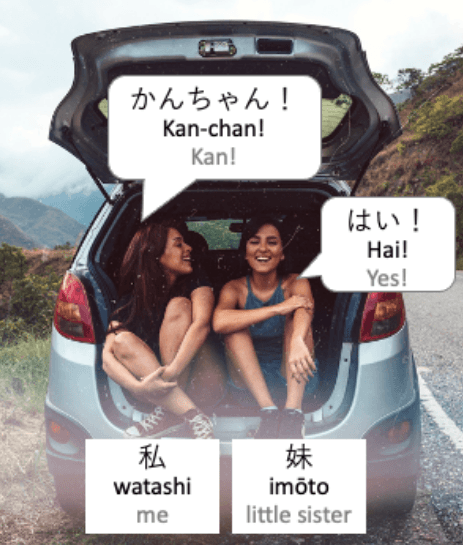
- かんちゃん! [Kan-chan!] (Kan!)
- はい! [Hai!] (Yes!)
Exercise 3: Fill in the blanks
Provide a particle in the blanks, so that it matches the English sentence.
毎日、朝八時起きてオフィス行く。
Mainichi, asa hachiji ... okite ofisu ... iku.
Everyday, I wake up at eight o’clock in the morning and go to the office.明日、駅前の広場コンサートがあります!
Ashita, ekimae no hiroba ... konsāto ga arimasu ... !
Everyday, I wake up at eight o’clock in the morning and go to the office.え、そうなんですか!
E, sōnan desu ka!
Oh, is that so?
土曜日、晴れれスキーに行こう
Doyōbi, harere ... sukī ni ikō ne.
If it’s sunny this Saturday, let’s go skiing.これはカニクリームコロッケですけど、それコロッケです。
Kore wa kani kurīmu korokke desu kedo, sore ... korokke desu ... .
This is crab cream croquette. That is also a croquette, right?音楽を聞き通学します。
Ongaku o kiki ... tsūgaku shimasu.
I go to school while listening to music.