Broadly, 〜てくる transcribed te kuru and 〜ていく transcribed te iku are used to indicate whether a verb is done “coming” or “going.”
- 途中で何か買ってきてTranscription: Tochū de nanika katte kiteTranslation: Please buy something on the way (here).coming, and buying something on the way.
- コンビニでおにぎり買っていくよTranscription: Konbini ni de onigiri katte iku yoTranslation: I’ll buy some rice balls at the convenience store on the waygoing, and buying something on the way
However, the nuances of when you should or shouldn’t use these endings can be tricky for learners. Sometimes the “coming” and “going” is about physical movement, as above. Other times, it’s a lot more abstract.
In this post, we’ll chat about how to use these two endings in a sentence, when to use them to talk about physical movement, and when you can use them in more abstract ways. Let’s have a look!
くる [kuru] and いく [iku]
The verbs くる transcribed kuru and いく transcribed iku are most often translated as “to come” and “to go,” though they can have other translations as well.
来る transcribed kuru is an verb, that describes movement toward the speaker.
昨日友達がうちに遊びに来た。Transcription: Kinō tomodachi ga uchi ni asobi ni kita.Translation: My friends came to my house for a visit yesterday.行く (iku) is a u-verb, describes a movement away from the speaker.
午後、スーパーへ買い物に行きます。Transcription: Gogo, suupaa e kaimono ni ikimasu.Translation: I’ll go to a supermarket this afternoon to shop.
How to use 〜てくる [te kuru] and 〜ていく [te iku]?
The endings 〜てくる transcribed te kuru and 〜ていく transcribed te iku can be used to explain how or why someone came or went. You might add these endings to another verb, like 走る transcribed hashirumeaning to run, to show that someone runs toward the speaker or away from the speaker.
- 走ってくるTranscription: hashitte kuruTranslation: come running
- 走っていくTranscription: hashitte ikuTranslation: run away
Though they often describe physical movement towards or away from the speaker, they can also be used to describe abstract movement through time. We’ll talk a bit more about that later!
These endings are made of two parts: the a -te form and a helping verb. The -te form describes how or why someone traveled, while the helping verb, くる transcribed kuruand いく transcribed iku, tells you about the direction of motion.
-te form
how they traveled
くる transcribed kuru or いく transcribed iku
Let’s look at each of these two parts!
The -te form is a form used to connect elements in Japanese. In this case, it connects a word with a helping verb that gives it an extra layer of meaning. The -te form will usually end in 〜て transcribed te, but can sometimes end in 〜で transcribed de instead.
Japanese helping verbs are called 補助動詞 transcribed hojodōshi. When a verb is used as a helping verb it’s usually spelled in hiragana, くる and いく, but it’s conjugated just like an independent verb.
Physical movement: 〜てくる [te kuru] and 〜ていく [te iku]
Adding 〜てくる transcribed te kuru to a sentence indicates movement toward the speaker, while adding 〜ていく transcribed te ikut indicates movement away from the speaker, or that the speaker is moving. But when should we add this ending?
Here are the main cases where you might add 〜てくる transcribed te kuru or 〜ていく transcribed te iku:
To indicate what someone did before arriving, coming or going
To indicate that someone was transporting or traveling with something
To describe the method or manner by which someone came or went.
To clarify how the direction relates to the speaker’s location.
Let’s look more closely at each and go through some example scenarios!
What someone did before arriving (coming or going)
You can use 〜てくる transcribed te kuru and 〜ていく transcribed te iku to mark an action that someone did before arriving somewhere, coming or going. This can be something that you “stopped off” to do while on your way, or it can be something you just get done before arriving. Let’s look at some scenarios where you might use this!
Stopping in on your way
Two friends are talking on the phone, from different locations. Friend B is traveling to visit Friend A, and will pass a store on the way.
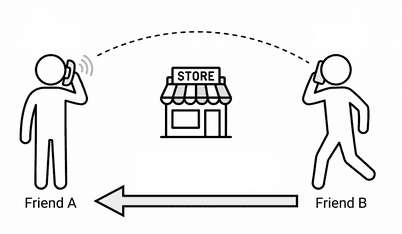
Here is their conversation:
Speaker A:冷蔵庫が空だから、途中で何か買ってきて。Transcription: Reizōko ga kara da kara, tochū de nanika katte kite.Translation: My fridge is empty, so please buy something on the way (here).Friend B should stop in and buy something while traveling towards the speaker.Speaker B:じゃあ、コンビニでおにぎり買っていくよ。Transcription: Jā, konbini ni de onigiri katte iku yo.Translation: Well then, I’ll buy some rice balls at the convenience store on the way.Friend B is moving, and will stop in and buy something while traveling away from their current position.Something to accomplish before returning
Friends A and B are chatting in the living room. They are getting thirsty, so Friend A decides to step into the kitchen to make some tea.
Friend A:お茶いれてくるから、ちょっと待ってて。Transcription: Ocha irete kuru kara, chotto mattete.Translation: Just a moment, I’ll make tea and come back.Friend A will make tea before arriving back at their current location.Adding 〜てくる transcribed te kuru, here, makes it clear that Friend A is leaving the room to make tea, and will be coming back. Without this ending it would sound like Friend A didn’t have to leave the room to make tea.
In English you might express this by saying say “I’ll go and make tea.” In Japanese, though need to use 〜てくる transcribed te kuru because it’s a task you want to get done before you come back to where you are.
Something to accomplish before leaving
A and B are still at A’s place. It’s almost dinner time. When B says they are heading home, A asks B to stay for dinner.
Friend A:晩ごはん食べていってよ。お寿司とるから。Transcription: Bangohan tabete itte yo. Osushi toru kara.Translation: Have dinner with me before you go. I’ll order sushi.Literally: Eat dinner and then go.In this case, Friend A is asking Friend B to do something before they leave. 〜ていって transcribed te itte, or its polite form 〜ていってください transcribed te itte kudasai is a handy phrase we can use to ask someone to stay for some activity!
Transporting something or traveling with something
You can use 〜てくる transcribed te kuru and 〜ていく transcribed te iku after certain static verbs to indicate that you brought, wore, or held something, or that you brought someone with you.
To do this, just take a verb for a continuous transitive action, such as holding something, wearing something, or accompanying someone, and add 〜てくる transcribed te kuru or 〜ていく transcribed te iku to indicate the direction of travel.
| Verb | Example |
|---|---|
連れる Transcription: tsureru Translation: to accompany | 子供を病院に連れていくので、少し遅れます。 Transcription: Kodomo o byōin ni tsurete iku node, sukoshi okuremasu. Translation: I’m taking my child to a clinic, so I’ll be a little late. Literally: I’m going, accompanying my child, to the hospital… |
持つ Transcription: motsu Translation: to hold | その本、読みたいから、持ってきて。 Transcription: Sono hon, yomitai kara, motte kite. Translation: I want to read the book, so please bring it with you. Literally: ...come holding the book. |
かぶる Transcription: kaburu Translation: to wear (hats) | 外は暑いから、帽子をかぶっていきなさい。 Transcription: Soto wa atsui kara, bōshi o kabutte ikinasai. Translation: It’s hot outside, so wear your hat when you go out. Literally: ...go wearing your hat. |
The method or manner of movement
You can also add 〜てくる transcribed te kuru or 〜ていく transcribed te iku to a verb that describes a type of movement, like 歩く transcribed arukumeaning to walk, 走る transcribed hashirumeaning to run, or 飛ぶ transcribed tobumeaning to fly. This indicates how you came or went: the method of the movement.
You can also use non-movement verbs like 座る transcribed suwarumeaning to sit and 眠る transcribed nemurumeaning to sleep to describe your condition or position while you traveled.
Relating a directional movement to the speaker’s location
Some verbs, like 帰る transcribed kaerumeaning to return and 送る transcribed okurumeaning to send have some directionality built into them. However, adding 〜てくる transcribed te kuru or 〜ていく transcribed te iku to these verbs helps clarify where the speaker is relative to that movement.
The subject moves
Verbs describing how the subject moves, can often be used with either 〜てくる transcribed te kuru or 〜ていく transcribed te iku. Compare these two statements, both of which might be made at the end of a school day:
The object moves
Japanese verbs for “sending something” are assumed to represent travel away from the speaker. However, you can add 〜てくる transcribed te kuru to these verbs if something was being sent to you. Compare:
- 私は祖母にお菓子を送った。Transcription: Watashi wa sobo ni okashi o okutta.Translation: I sent some sweets to my grandmother.We assume that the motion is away from the speaker.
- 祖母がお菓子を送ってきた。Transcription: Sobo ga okashi o okutte kita.Translation: My grandmother sent me some sweets .Here, we clarify that the motion is towards the speaker.
Sometimes whatever is being sent is a little abstract: a message rather than an object.
Less literal uses of 〜てくる [te kuru] and 〜ていく [te iku]
We saw how 〜てくる transcribed te kuru and 〜ていく transcribed te iku can mark actions that physically come and go from a particular place, but these endings can also mark verbs that “come” or “go” from abstract states or times. For example, 〜てくる transcribed te kuru and 〜ていく transcribed te iku can be used in the following cases.
To mark an action or condition that lasted until or continued after a reference point.
To indicate whether a gradual change makes things more or less like the state you have in mind.
To mark a feeling that “rises up” quickly or suddenly within someone (〜てくる transcribed te kuru only)
To mark that something has become perceptible to the senses (〜てくる transcribed te kuru only)
Let’s have a look at each of these uses more closely!
Something continues until or began after a reference point
〜てくる transcribed te kuru and 〜ていく transcribed te iku can mark an action or situation that continued until or began after some point in time.
action/situation before
reference point
action/situation after
Regardless of when your “reference point” is, the tense of 〜てくる transcribed te kuru and 〜ていく transcribed te iku should be relative to “now.”
A change moves things towards or away from some state
When added to a verb of unintentional change, like なる transcribed narumeaning to become or 変わる transcribed kawarumeaning to change, 〜てくる transcribed te kuru and 〜ていく transcribed te iku can indicate whether the change makes things gradually more or less like the state you have in mind.
〜てくる transcribed te kuru indicates things are becoming more like the state you describe.
〜ていく transcribed te iku indicates things are becoming less like the state you describe.
You can think of this as “coming into” a state or “going out of” a state. For example:
- 3月に入って、日がだんだん長くなってきた。Transcription: Sangatsu ni haitte, hi ga dandan nagaku natte kita.Translation: March has arrived, and the daylight time is gradually getting longer.Days are getting closer to being long.
- この町はこれからもどんどん変わっていくことだろう。Transcription: Kono machi wa kore kara mo dondon kawatte iku koto darō.Translation: I think this town is going to steadily keep changing in the future as well.Things are becoming less familiar.
You can use this to describe a change in your feelings or level of understanding:
It can also include the gradual appearance or disappearance of something:
Remember, though, that the change is always gradual. Sentences that use 〜てくる transcribed te kuru and 〜ていく transcribed te iku this way often include adverbs like だんだん transcribed dandanmeaning gradually, どんどん transcribed dondonmeaning steadily, and 少しずつ transcribed sukoshi zutsumeaning little by little. Can you spot them in the examples above?
A feeling “rises up” (〜てくる [te kuru] only)
You can add 〜てくる transcribed te kuru to certain verbs in order to express that a feeling is suddenly rising up within you. You’ll commonly hear this with verbs like 込み上げる transcribed komiagerumeaning to well up or expressions like 眠気がおそう transcribed nemuke ga osoumeaning to be overcome by drowsiness.
Though the verbs themselves express the change of state, adding 〜てくる transcribed te kuru makes it sound sudden, fast, or uncontrollable.
- 古い写真を見ていると、なつかしさが胸に込み上げてきた。Transcription: Furui shashin o mite iru to, natsukashisa ga mune ni komiagete kita.Translation: As I looked at old photos, I felt nostalgia welling up in my heart.
- 授業中、急に眠気がおそってきた。Transcription: Jugyōchū, kyūni nemuke ga osotte kita.Translation: During the class, I was suddenly overcome by drowsiness.
Something becomes perceptible to the senses (〜てくる [te kuru] only)
You can add 〜てくる transcribed te kuru to a sensory verb to indicate that a sound or smell has started to reach you. You might use this with verbs like 聞こえる transcribed kikoerumeaning to be audible; hear, においがする transcribed nioi ga surumeaning to smell, or 見える transcribed mierumeaning to be visible; see.
- 台所からいいにおいがしてきた。今日はカレーだな。Transcription: Daidokoro kara ii nioi ga shite kita. Kyō wa karē da na.Translation: A nice aroma has started coming from the kitchen. I bet we are having curry today.
- 霧が薄らいで、湖が見えてきた。Transcription: Kiri ga usuraide, mizu’umi ga miete kita.Translation: The fog started thinning, and the lake gradually came into my view.
Bringing up a new topic of conversation (〜てくる [te kuru] only)
Finally, one last use for 〜てくる transcribed te kuru! This ending can be used as a communication device to indicate that you’re providing or suggesting a new topic of conversation. For example, if you want to tell someone that you saw the latest movie from Ghibli yesterday, you could phrase it two different ways:
- きのう、ジブリの新作を見ました。Transcription: Kinō, Jiburi no shinsaku o mimashita.This sounds like you’re saying this because it’s relevant to the conversation you’re already having. The person you’re talking to is expecting you to explain why what you’ve said is relevant.
- きのう、ジブリの新作を見てきました。Transcription: Kinō, Jiburi no shinsaku o mite kimashita.This sounds like you’re introducing a new topic of conversation, a little like if you’d introduced it with “by the way…” in English. The person you’re talking to is likely to take up this new topic and ask you how it was.
To sum up
In this post, we’ve found out how 〜てくる transcribed te kuru and 〜ていく transcribed te iku work in Japanese. Here’s a quick summary of all the uses of these two endings:
| Category | 〜てくる transcribed te kurumeaning coming | 〜ていく transcribed te ikumeaning going |
|---|---|---|
| Pysical Movement | actions done before you arrive | actions done before you leave |
bringing something | taking something away | |
how you came | how you left | |
towards the speaker | away from the speaker | |
| Abstract | continues before a reference time | actions done before you leave |
gradual change into a state | gradual change out of a state | |
emotional state “rises up” | ||
becomes perceptible to the senses | ||
introducing a new topic |
Ready to practice what you’ve learned? Check out our 〜てくる transcribed te kuru and 〜ていく transcribed te iku activity sheet to test your skills! Happy learning!