
In English, we use there is and there are to form existential sentences. Existential sentences say that something or someone exists in a place, time, quantity, or situation. Here are some examples:
- There are 15 kids in that class.
- There is a fly in the house.
- There was a show last week in New York.
The word there is called the existential there when it is the of an existential sentence. Using existential there is quite easy, and existential sentences are useful once you get to know them. Let’s take a closer look!
What is existential ‘there’?
Existential there is a . We use it like other English pronouns, except it does not refer to any specific person, place, or thing.
Pronouns like existential there, which don’t point to another noun, are called expletive pronouns or dummy subjects. In English, all sentences have a subject, so we need there to be the subject, even when it has no real meaning.
We use existential there as the subject of sentences that say something exists in a place, at a time, in a situation, or in a certain quantity.
- There is a fish in the pond.
- There were thirty animals at the zoo.
- There is some soup on the floor.
When to use existential ‘there’ in a sentence?
Simply put, we use existential there to indicate that something exists. Here is a simple chart to look at some of the common uses of existential there:
| Existential there functions | |
|---|---|
| Function | Example |
to say something exists | There is a type of dog called a xoloitzcuintli. |
to say something exists at a time | There is a dog show at 8 o’clock. |
to say something exists at a place | There is a dog in the house. |
to say something exists in a quantity | There are two dogs. |
Let’s look at a few more rules for using existential there correctly:
Use existential ‘there’ with indefinite nouns
You might notice in the chart that we don’t use existential there with definite nouns.
We also don't use existential there with proper nouns, because proper nouns are definite.
Use existential ‘there’ to describe the size of a group
We usually use existential there to describe the size of a group, especially groups of people.
- ✅ There are six of us.
- ❌ We are six.
- ✅ There are twelve people in her family.
- ❌ Her family are twelve people.
However, it is okay to describe the size of a group without existential there, if the number word comes before to be.
- ✅ There are twelve people in her family.existential there ✅
- ❌ Her family are twelve people.number after to be ❌
- ✅ Twelve people are in her family.number before to be ✅
Very rarely, English speakers will describe the size of a group with a prepositional phrase (in my family, at my wedding, under the bed,...) before to be. This usually sounds very old-fashioned and literary, so it is best to use existential there.
- ✅ In my family are twelve people.
- ✅ At my wedding were fifty people.

How to make a sentence using existential ‘there’?
Forming sentences with existential there is pretty straightforward! The most common sentence construction uses there + be + noun.
The only tricky part is you have to figure out whether to use a singular verb or a plural verb. Here is the rule:
To say one thing exists → use a singular verb
To say more than one thing exists → use a plural verb
Let’s look at some examples!
To say that one thing exists
To say that just one thing exists, we use there + singular verb (is, was, has been, ...) + singular noun.

We use the singular verbs is, was, and has because we are saying that one thing exists on the sofa: a cat.
You also use the singular verb form with mass nouns:
To say that more than one thing exists
To say that more than one thing exists, we use there + plural verb (are, were, have been, …) + plural noun.
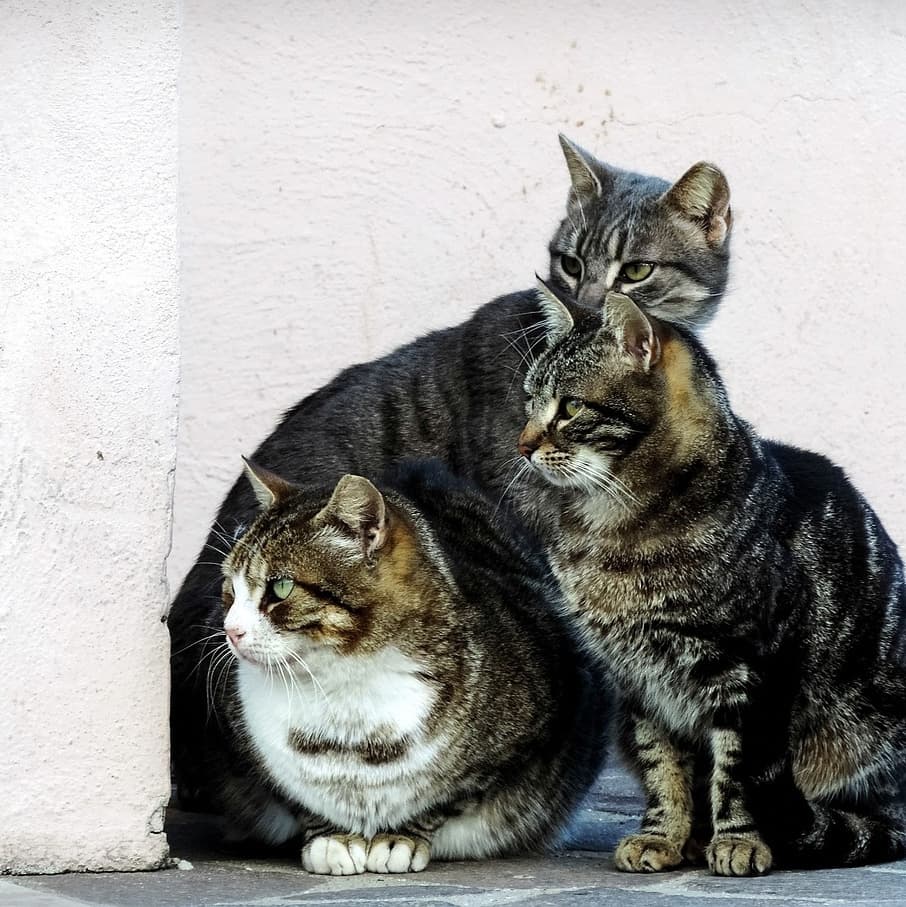
The plural verbs are, were, and have are used here because we are saying that more than one thing exists: three cats.
How to make an existential sentence negative?
Making an existential sentence negative is also pretty simple! Just add the adverb not (or the contraction n’t) after the verb.
not / n't
If the sentence uses an auxiliary verb (have, will, could, etc.) put not after the auxiliary verb:
How to ask if something exists?
To form a question with existential there, we just place the verb to be in front of there. Let’s use a couple examples from above:
- Is there a cat on the sofa? → There is a cat on the sofa.
- Are there two dogs? → There are two dogs.
- Is there water in your bottle? → There isn’t water in my bottle.
We often add the word any when we ask about a mass noun or about a plural noun, if you are not asking about a specific number.
- Is there any air left in the balloon? → There isn’t any air left in the balloon.
- Are there any dogs in the house? → There are dogs in the house.
We can also use there is / there are in shorter, informal answers:
- Is there a sale at the supermarket? → No, there isn’t.
- Are there any boats on the river? → Yes, there are.
- Is there any ice left in the freezer? → No, there isn’t.
- Are there any brown bears where you live? → No, there aren’t.
What verbs to use with existential ‘there’ besides ‘to be’?
Although to be is the most common verb with existential there, sometimes other verbs are used as well!
- There exist more than 3,000 snake species on earth today.
- There came a mighty crash!
The other verbs used with there have a more literary or poetic feel, and are usually only used in writing. Here are some verbs you might occasionally see with existential there:
| Verbs to use with existential there | |||
|---|---|---|---|
be | exist | occur | appear |
come | emerge | erupt | float |
ascend | spring | stand | arise |
What is the difference between existential ‘there’ and the adverb ‘there’?
In English, we can also use there as an . The adverb there describes where something happened by pointing to a particular place. Here's an example:
So what’s the difference? When we use there in an existential sentence, (a) it acts as the subject of a sentence, (b) it says that something or someone exists, and (c) it does not point to a particular place. Here is one last example to help us see the difference:
What is the difference between ‘it is’ and ‘there is’ sentences in English?
In a nutshell, we use there is sentences to say that something exists, and we use it issentences to describe the state of the world and general truths.
- There is snow on the ground.snow exists on the ground
- It is snowy today.the world/situation is snowy
Both existential there and empty it are pronouns that do not point to specific things, and so they are both called dummy subjects or expletive pronouns. But the dummy subject that you use tells us what kind of sentence you are making.
In summary
We have just talked about when and how to use existential there in English. Starting a sentence with there is, there are, or there’s can help you say when, where, or how many of something exist. There are a few important rules and exceptions to remember:
An existential sentence has the form: there + verb + noun. The verb is usually to be.
Use existential there with indefinite nouns.
We usually describe the size of groups using there + be.
Use a singular verb to say one thing exists, and a plural verb to say more than one thing exists.
We have prepared these short existential sentence exercises using there so you can put your knowledge to the test. Happy learning!