
In English, you can tell someone the time in two ways — by saying the hours then the minutes or by saying the minutes then the hours.
7:20
But if you want to really talk about the time of day in English, there is a lot more to learn! In this post, we’ll take a look at how to read the clock exactly, how to say the time casually, and how to describe the general time of day. By the time you finish this post, you’ll never have to worry again that you won’t arrive on time!
How to give the exact time in English?
The easiest and most common way to say the exact time is hour + minutes. Both numbers are .
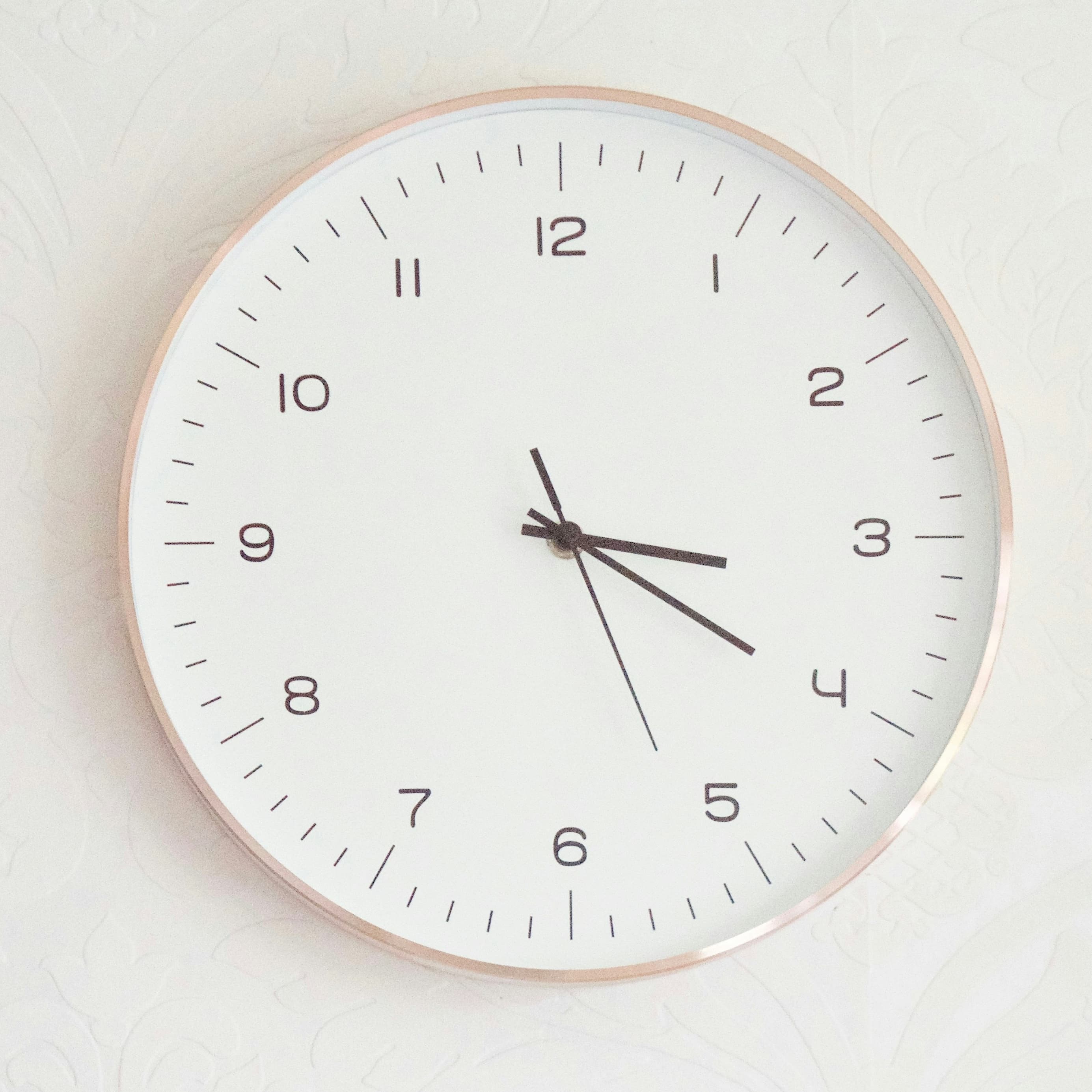
- Speaker A:“What time is it?”Speaker B:“It’s three twenty.”(3:20)
- Speaker A:“When does the meeting start?”Speaker B:“The meeting starts at ten fifteen.”(10:15)
- “My mom’s flight is supposed to arrive at seven fifty-one.”(7:51)
- “I have been waiting since one thirty.”(1:30)
Here are two important things to remember when you’re reading the exact time:
When the minutes are in the single digits (1-9), you say the time as “oh” + single digit. This is only used for saying the time out loud, not writing it.
8:05
- ✅ It’s eight “oh” five.
- ❌ It’s eight five.The 0 is always pronounced.
- ❌ It’s eight zero five.The 0 is always pronounced as “oh”.
We often use the word o’clock (from “of the clock”) after the hour, when the time is exactly at the hour. We don’t use o’clock when there are minutes that follow the hour.
- ✅ My job starts at nine o’clock.(9:00)
- ❌ Right now it’s five forty-one o’clock.(5:41)
→ Don’t use o’clock if you are not giving an exact hour!
How to use a.m. and p.m. in English?
In the US, the day is divided into two twelve hour periods. We use a.m.
to indicate the hours from midnight meaning 00:00 on a 24-hour clock to noon (12:00 on a 24-hour clock), and we use p.m. to indicate hours from noon to midnight.
- ✅ My sister is a night shift nurse and she starts work at 10:00p.m.
- ✅ The school bus arrives at our house around 7:35a.m.
Midnight is 12:00 a.m. and noon is 12:00 p.m., but we only use a.m. and p.m. when we are reading the clock in hour + minute form, not when we are giving an approximate time.
- ✅ Craig always takes his lunch break at noon.
- ❌ Michele usually goes to bed around midnight a.m.
What verb to use when you read the clock?
In English, we use the be to describe time. We usually think of time as one singular moment, so would use the singular form of the verb it is or it’s to say the current time:
3:07
- ✅ It’s 3:07p.m.
- ❌ They are 3:07p.m.Use the singular!
- ❌ It has 3:07p.m.Use be!
When describing past times use it was:
It was 4:00 when we arrived.When describing future times use it will be:
It will be 4:00 when we arrive.
How to describe the time of an event?
We use the at to before the time or starting time of an event (e.g. at 4 p.m., at 10:30 a.m.). The phrase at + time comes after the verb.
- ✅ My dentist appointment is at 4:00 p.m.
- ✅ The meeting starts at 10:30 a.m.
- ❌ The meeting starts on 10:30 a.m.
When we want to say both the starting time and the ending time, we use the prepositions to and from. The word from can be deleted in informal speech:
starting time
ending time
In writing you can just use a hyphen (-) between the two times: 12:00-12:30.
How to give the time with ‘past’, 'after', and ‘to’ in English
When we give the time with past and to in English, we start with the minutes first, like this:
past / after/ to
hour
Here’s some more details to help you use this formula correctly:
We use past (or sometimes just after) to say how many minutes after the hour it is. So we are adding minutes to the hour.
- The bus arrives at twenty-two minutes past four.4:22 (4:00 + 22 minutes)
- Class starts at fifteen minutes after eight.8:15 (8:00 + 15 minutes)
We use to (or rarely of or till) to say how many minutes after the hour it is. So we are subtracting minutes from the next hour.
- The movie starts at six to eight.7:54 (8:00 - 6 minutes)
- My dance class starts at fifteen minutes to six.5:45 (6:00 - 15 minutes)
- The train will depart at twenty to two.1:40 (2:00 - 20 minutes)
Generally, we use past / after for times between X:00 - X:30 and to / of / till for times between X:30 and X:00.
How to give an approximate time?
We also use past and to when we give an approximate time. We usually give approximate time to the nearest 15 minutes or 30 minutes.
There are two words we commonly use to describe 15 minutes of time and 30 minutes of time:
- quarterTranslation: (15 minutes = ¼ hour)
- halfTranslation: (30 minutes = ½ hour)
You can use quarter when the time is 15-minutes after (past) or 15-minutes before (to) the hour.
- It’s a quarter past four.4:15 (4:00 + ¼ hour)
- The lecture starts at quarter to two.1:45 (2:00 - ¼ hour)
You can use half to describe the time past the hour (half past), but we don’t use half to describe the time until the next hour (to):
- ✅ My favorite TV show starts at half past seven.7:30 (7:00 + ½ hour)
- ❌ My favorite TV show starts at half to eight.We don’t use half with to, so say 7:30 as half past seven instead.
Sometimes we look at the exact time and round that up to the nearest 15 or 30 minute increment. So if it’s 3:27, I might say that it’s half past three.
How to describe the time of day in English?
We saw above that, when you give an exact clock time, we use a.m. or p.m. to describe the time of day. But if you’re being more casual it is more common to use less formal phrases like the ones below.
Morning refers to any time from midnight meaning 00:00 to noon meaning 12:00. We use the phrase in the morning to describe events that take place during this time period:
Why are you awake? It’s 4 o’clock in the morning.The only appointments available on that day are in the morning.Afternoon refers to any time from noon to about 5:00 p.m., which is the typical end of the work day in the US. We use the phrase in the afternoon to describe events during this time period:
- I usually go to the gym in the afternoon.
- The study group meets from 1:30 to 3:30 in the afternoon.
Evening refers to any time from about 5:00 p.m. to when the sun sets. We usually use the phrase in the evening to discuss events that happen in this time period:
- My family usually watches a movie in the evening.
- I can meet you around 6:00 in the evening.
Night refers to any time from when the sun sets until the sun rises. Unlike the other periods of the day, we use at night to describe events that happen in this time period:
- I prefer to be awake at night because it’s very quiet.
- My cat is most active around 11 at night.
Remember that the words morning, afternoon, evening, and night do not tell you the specific time. If there is any confusion about the time of day, you can always ask someone what they mean exactly!
Summary
In this post, we’ve talked about a lot of ways to describe a time like 4:45 p.m. in English:
Saying the hours and then minutes (ex: fifteen minutes to five)
Saying the minutes + past/after /to+ hour (ex: four forty-five)
Saying the time casually with quarter and half (ex: quarter to five)
Saying the general time of day (ex: late afternoon)
We also went over some other rules for giving clock times:
Use the 12-hour clock, with a.m. and p.m.
Use the verb be to give the time.
Use from + time + to + time to describe the start and end of an event.
Now that you know more about discussing the time in English, practice these skills with our activities to practice telling time in English. Or, if you’re ready to learn something new, you can learn more about how to describe the time of an event in English from our post on English prepositions of time!