Add-on · Little Pim
Language immersion for your youngest learners
Little Pim introduces a language to two- to six-year-olds through short animated videos built around the parts of a day they already know. It's an add-on to Mango for K-12, and it runs inside the apps your school already has.
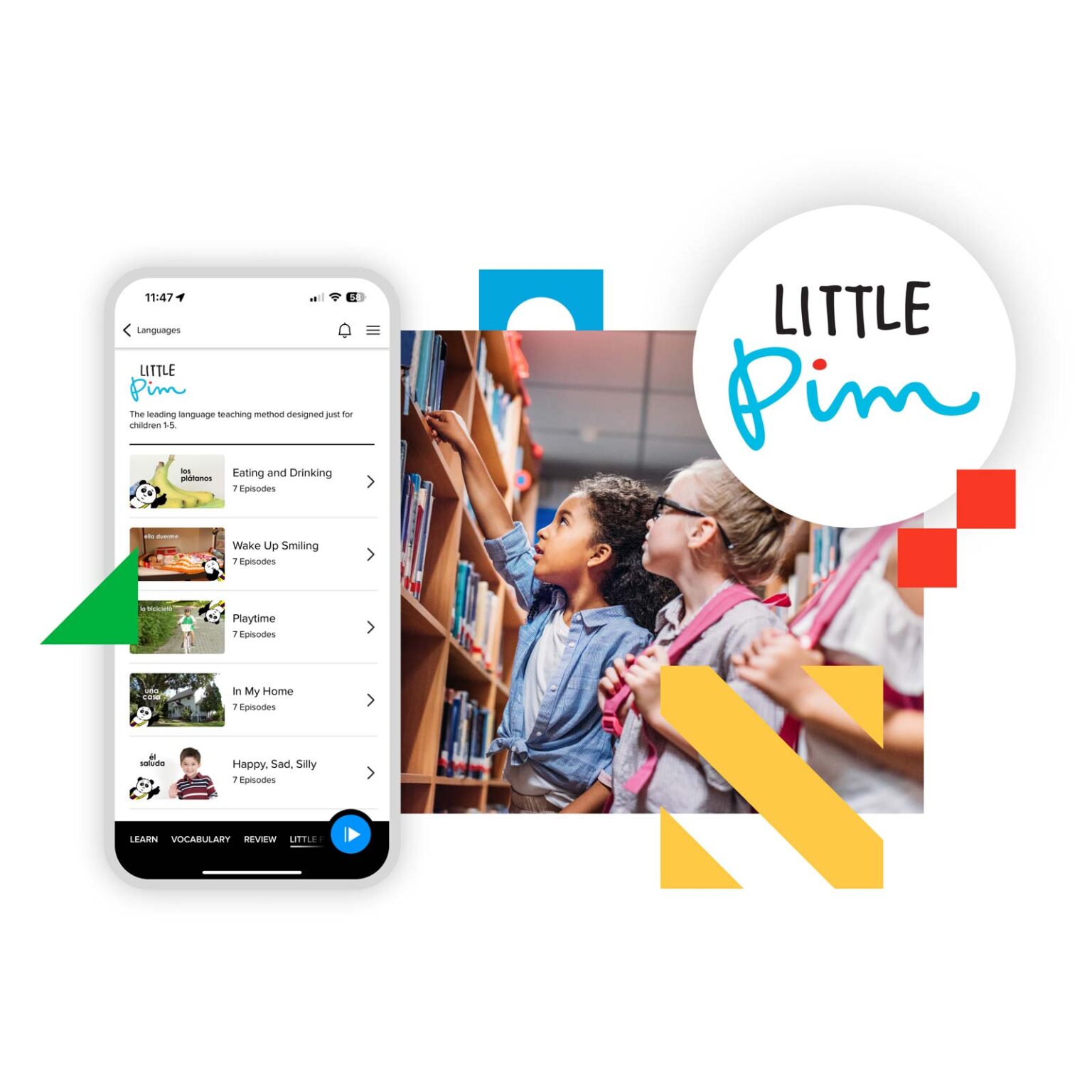
How it works
Built for ages two to six
Little Pim works differently from the rest of the platform, and the differences matter when you're planning around it.
Video, with a grown-up alongside
Short animated episodes led by a panda character, designed to be watched with a teacher or parent rather than alone. The adult co-viewing is part of the method, not a supervision requirement.
Everyday routines, not vocabulary lists
Language arrives through the things a small child already does, like meals, getting dressed, playing and counting, so the words attach to something familiar.
Ages two to six
Pre-K & lower elementary
This is an early-childhood product. It suits a pre-K or lower-elementary setting and is not a school-aged academic course. For those, the platform's own courses are the answer.
No quizzes, and no progress data
Little Pim is watching, not assessment: there are no quizzes, no vocabulary cards and nothing that feeds the reporting dashboards. Plan for it as enrichment rather than as something you will report on.
Inside the app you already have
Not a separate app to deploy. Little Pim courses appear in the Mango apps on web, iOS and Android alongside the world languages, so there is nothing extra for IT to roll out.
The catalogue
Twelve languages, in two depths
Twelve languages ship, but they are not all the same size. Half carry the full set of themes and half stop after the first three. Here's which is which, so you can check before you plan.
French, Latin American Spanish, Italian, German, Mandarin Chinese, English
6 themes · 42 videos
The full set. Six thematic units, at seven short videos each, built from a young child's day: eating and drinking, waking up, playtime and on. The English course is aimed at children whose home language is something else.
Hebrew, Japanese, Modern Standard Arabic, Russian, Korean, Brazilian Portuguese
3 themes · 21 videos
These six cover the first three themes only. It is worth checking against the languages your families actually speak before you plan a unit around one of them.
Where it fits
An add-on, quoted separately
Little Pim is opt-in for K-12 rather than part of either tier, so it arrives as its own line item on a quote. It is worth deciding early whether your program genuinely reaches down to pre-K. For a school-aged class, the platform's own courses on Mango Passport or Mango Classroom are the right answer, and Little Pim will feel too young.
One planning note if you run the K-5 Spanish program that comes free with Mango Classroom: its Kindergarten guide leans on Little Pim, so that year of the plan assumes a purchase the tier doesn't include.
Add Little Pim to your language program
Talk to our K-12 team about Little Pim for your earliest grades.